What Size Water Softener Do I Need? The Grain Math
What size water softener do I need? People × gallons × hardness × days gives grains per cycle. Worked for four US cities with manufacturer ratings.
"What size water softener do I need?" has a short answer: multiply the people in the house by the gallons each uses per day, multiply by your hardness in grains per gallon, and multiply by the number of days you want between regenerations. That product is the grains one cycle has to remove. Then pick a unit whose rating at the salt dose you will actually run is larger than that number.
Penn State Extension's own sample shows how small the arithmetic is: four people at 75 gallons each, on 10 grain-per-gallon water, use 3,000 grains of softening a day, so a unit delivering 20,000 grains per regeneration lasts about six to seven days. Everything below is about the parts that make that arithmetic go wrong: where each input comes from, why the number on the box is not the number you get, and what the grain figure does not size at all.
The formula, one step at a time
| Step | Formula | Penn State's example |
|---|---|---|
| 1. Daily water | people × gallons per person per day | 4 × 75 = 300 gallons |
| 2. Daily hardness load | daily gallons × hardness in gpg | 300 × 10 = 3,000 grains |
| 3. Load per cycle | daily grains × days between regenerations | 3,000 × 7 = 21,000 grains |
| 4. With a reserve | load per cycle × (1 + reserve) | your choice; 20% gives 25,200 |
| 5. Compare | rating at your salt dose ≥ step 4 | see the manufacturer tables below |
The units cancel cleanly because a grain per gallon is literally a mass of hardness in each gallon. Gallons times grains-per-gallon gives grains, and a softener's capacity is rated in grains. No conversion factor appears anywhere in the sizing, which is why the one place a conversion does appear — turning a ppm figure into grains per gallon before you start — is the place to be careful. Divide ppm by 17.1, and if your report is in parts per billion, divide by 1,000 first. The ppm to gpg guide covers that step and the mistakes it invites.
The grain capacity calculator on this site runs exactly these five steps with every assumption visible and editable, so you can change one input and watch the rest move.
Where each input should come from
Hardness. This input does the most work and is the one people take least care over. A utility report gives a figure for the whole system over a sampling period. A test at your own tap gives a figure for your water on one day. For sizing, the tap test is the better input; the utility figure is a reasonable starting point if it is a narrow range. If you are on a private well, there is no utility figure to borrow at all, as municipal water hardness vs well water explains.
If you test with strips, know what kind of number you will get. Strips report a colour block, not a continuous reading. LaMotte's Insta-TEST low range hardness strips, for example, are specified at 0, 30, 60, 120 and 180 ppm. Hach sells total hardness strips covering 0 to 425 mg/L. A strip tells you which band you are in, which is often enough for sizing, but it is not a three-significant-figure measurement and should not be treated as one.
Iron. Clear-water (ferrous) iron uses up resin capacity too. Both the GE GXSF30V and the Whirlpool WHES40/WHES44 owner's manuals tell you to add 5 to the hardness number for each 1 ppm of iron; their shared worked example turns 20 gpg with 2 ppm iron into a sizing and setting figure of 30. The University of Minnesota Water Resources Center suggests considering a separate iron filter if iron is above 3 ppm, and Penn State notes that red, oxidised iron clogs resin rather than being removed by it.
People. Count everyone whose water passes through the softener. That sounds obvious, but it matters most in a house with seasonal occupants or long-term guests: sizing for the household you have most of the year and setting a shorter cycle for the busy weeks is usually better than sizing for the peak.
Gallons per person per day. Penn State's sample uses 75, and this site's calculator uses 75 as a default, labelled as an assumption. It is a placeholder, not a statistic about your house. Your water bill divided by the days in the billing period and the number of people is a far better number, especially if you subtract irrigation, which Penn State notes can be left unsoftened along with toilets and outside spigots.
Days between regenerations. This is a choice, not a measurement. The University of Minnesota Water Resources Center says softeners should be sized to work three to five days without regeneration. Penn State's example lands at six to seven. Shorter cycles let you use a smaller unit at a lower, more salt-efficient dose; longer cycles mean a bigger unit regenerating less often.
What size water softener do I need in four real cities?
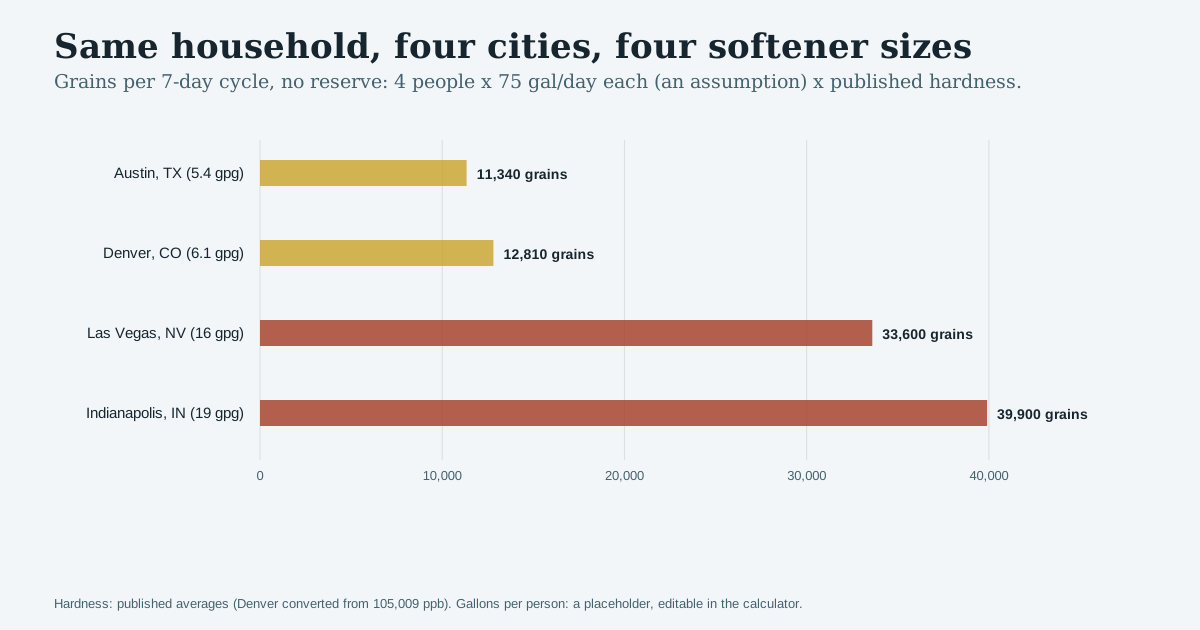
Here is the same household — four people, 75 gallons each, so 300 gallons a day — sized against the published average hardness of four US water systems. The hardness figures are each utility's own, as published. The 75 gallons is an assumption and the same in every row, so the only thing changing is the water.
| System | Published average | Grains per day | 4-day cycle | 7-day cycle | 7-day + 20% reserve |
|---|---|---|---|---|---|
| Austin Water | 5.4 gpg | 1,620 | 6,480 | 11,340 | 13,608 |
| Denver Water | 6.1 gpg (from 105,009 ppb) | 1,830 | 7,320 | 12,810 | 15,372 |
| LVVWD, Las Vegas | 16 gpg | 4,800 | 19,200 | 33,600 | 40,320 |
| Citizens Energy Group, Indianapolis | 19 gpg | 5,700 | 22,800 | 39,900 | 47,880 |
The spread is the point. The Indianapolis household needs three and a half times the capacity per cycle of the Austin household, for the same people using the same water. Household size is the input everyone asks about first, and hardness is the one that moves the answer most.
Two notes on the figures. Indianapolis publishes 317 ppm alongside 19 grains per gallon; 317 divided by 17.1 is 18.5, so the utility's own grain figure is rounded, and this table uses what the utility printed. Denver publishes in parts per billion, so its 105,009 ppb is 105.009 mg/L, which is 6.1 grains per gallon.
The rating on the box is not one number
This is the part most sizing advice skips. A softener's grain capacity depends on how much salt it uses to regenerate, and manufacturers publish several capacities for the same unit. These come straight from the owner's manuals.
| Unit | Low salt dose | Middle dose | High dose |
|---|---|---|---|
| GE GXSF30V | 11,900 grains at 2.5 lb | 25,300 grains at 7.9 lb | 30,100 grains at 13.3 lb |
| Whirlpool WHES40 | 11,900 grains at 2.4 lb | 31,600 grains at 9.0 lb | 40,000 grains at 15.5 lb |
| Whirlpool WHES44 | 13,000 grains at 2.6 lb | 34,800 grains at 9.7 lb | 44,000 grains at 16.7 lb |
Divide grains by pounds of salt and the pattern is obvious. The WHES40 removes about 4,958 grains per pound at its lowest dose, according to its manual, but 40,000 grains at 15.5 lb works out to about 2,581 grains per pound. The GE unit is rated at 4,770 grains per pound at 2.5 lb, and its manual states plainly that the efficiency rating "is valid only at the lowest stated salt dosage". At 13.3 lb its 30,100 grains is about 2,263 grains per pound.
So the top capacity figure is real, but it is the expensive way to run the unit. The University of Minnesota Water Resources Center recommends an efficiency rating of 4,000 grains per pound of salt or higher, and both GE and Whirlpool include a salt efficiency mode that operates at 4,000 grains per pound or better. Whirlpool's manual notes that in California the feature must be on.
What this means for sizing: compare your cycle load with the capacity at a dose you are happy to pay for in salt, and accept a shorter cycle if necessary. The Indianapolis household above needs 39,900 grains for a seven-day cycle, which is right at the WHES40's top figure at its least efficient dose. The same household on a four-day cycle needs 22,800 grains, comfortably inside the 31,600 the unit delivers at 9.0 lb. Both GE and Whirlpool describe their units as demand-initiated, regenerating based on the water actually used rather than on a fixed calendar, so in practice the controller makes much of this trade-off for you once the hardness is set correctly.
Size for the range, not just the average
Most utilities publish a range as well as, or instead of, an average, and that range is the honest version of the figure. Sizing the same household at both ends shows how much it matters.
| System | Published range | 7-day load, low end | 7-day load, high end | Ratio |
|---|---|---|---|---|
| Phoenix | 10 to 17.6 gpg | 21,000 | 36,960 | 1.8× |
| San Antonio | 15 to 20 gpg | 31,500 | 42,000 | 1.3× |
| Indianapolis | 8.7 to 27 gpg | 18,270 | 56,700 | 3.1× |
Same household, same assumptions as before. In Indianapolis the top of the published range needs more than three times the capacity of the bottom. No single average describes that system, and a unit sized to the average will run out early at an address served by water near the top.
There are two sensible responses. One is to size for the top of the range, which costs some up-front capacity but never runs short. The other is to test at your tap and size from that, which is what the range is effectively telling you to do. The calculator on this site sizes both ends automatically when you pick a utility that publishes a range, and prints the ratio between the answers.
Ranges can also be seasonal. Denver Water's quarterly samples run from 55,000 to 124,000 ppb, which is 3.2 to 7.3 gpg. A demand-initiated unit set to the higher figure simply regenerates a little more often than it strictly needs to in the softer months. The University of Minnesota Water Resources Center notes that softeners with hardness sensors are best suited to areas where hardness fluctuates, and suggests checking with your city.
What the grain number does not size
Grain capacity answers one question: how much hardness one cycle can remove. A softener has to satisfy several other limits too, all of which are in the manufacturer's specifications rather than in any formula.
Service flow. Capacity and flow are separate. The Whirlpool WHES40 is rated at 8.5 gallons per minute of service flow and the WHES44 at 9.0. A unit with plenty of grains can still be too small for a house running several showers and a washing machine at once. Check the rated service flow against your busiest hour, not your average day.
Maximum hardness and iron. The WHES40 manual gives a maximum hardness of 125 gpg and a maximum clear-water iron of 10 ppm; the WHES44 lists 140 gpg and 12 ppm. Ordinary municipal water is nowhere near the hardness limit, but well water with iron can approach the iron limit.
Water and drain. Every regeneration sends water to the drain. GE's manual lists 2.8 gallons per 1,000 grains at its minimum dose and 35.5 gallons per regeneration at the maximum. Whirlpool lists 37.1 gallons for the WHES40 and 43.2 for the WHES44 at maximum dose. Penn State estimates about 50 gallons per regeneration and points out that this may overload a septic drainage field, so septic households have a specific reason to prefer fewer, more efficient regenerations.
What to bypass. Penn State suggests showers, sinks and laundry should probably be softened, while toilets, outside spigots and basement sinks can be bypassed. Every gallon you route around the softener comes off the daily load in step 1.
Do you need one at all?
Sizing presumes the answer is yes, and on a lot of US water it is not obviously so. Penn State says levels below 7.0 gpg "will probably not cause major scaling and soap film". The University of Minnesota Water Resources Center says hardness of less than 5 to 7 gpg may be acceptable to many homeowners.
On this site's list, Portland's Bull Run supply is published at about half a grain per gallon, Boston's MWRA at 1 grain, Manchester at about 1, and New York City at an average of 2. There is very little hardness there to remove. Austin and Denver, at 5.4 and 6.1 gpg averages, sit in the zone both extensions describe as acceptable to many. The softening question gets serious in the very hard systems, such as Phoenix, Las Vegas, San Antonio and Indianapolis, and that is where the sizing above earns its keep. If you are not sure which system serves you, find your water system first.
There is also a sodium consideration. The exchange adds sodium to the water: Penn State puts it at 7.5 milligrams per quart for each grain per gallon removed, and Nebraska Extension, citing the Water Quality Association, at about 8 mg/L per grain. Some households soften only the hot water or leave a kitchen tap unsoftened for this reason.
Five sizing mistakes worth avoiding
Sizing from the box's biggest number. That figure is the capacity at the highest, least efficient salt dose. Compare with the capacity at the dose you intend to use.
Using a ppm figure as grains. Put 317 into a grains calculation instead of 18.5 and you size a unit seventeen times too large. Convert first.
Ignoring iron. Five extra grains per ppm of clear-water iron, per both manuals quoted here. At 2 ppm that is a 50% increase on 20 gpg water.
Using the average of a wide range. If your utility publishes 8.7 to 27 gpg, the average describes no particular tap. Size for the top or test your own water.
Forgetting flow. A unit with enough grains and too little service flow will still disappoint during the busiest hour of the day.
Sources and further reading
Sizing method and sample figures: Penn State Extension, Water Softening (updated 8 September 2025). Sizing interval, efficiency and hardness guidance: University of Minnesota Water Resources Center, Residential softening. Sodium per grain: Nebraska Extension, Hard Water (Calcium and Magnesium), G1274. Unit ratings, iron compensation, flow and water per regeneration: the GE GXSF30V owner's manual and the Whirlpool WHES40/WHES44 owner's manual. Test strip ranges: LaMotte Hardness Low Range Test Strips and Hach Total Hardness Test Strips. All read 17 October 2026. Utility figures come from each utility's own report, cited with its retrieval date on its page here, and every assumption in the calculator is listed on the methodology page.
So the answer to what size water softener do I need is the grains your household removes in one cycle, compared against the capacity a unit delivers at the salt dose you will actually run — with hardness from the top of your range or from your own tap.
Frequently asked questions
What size water softener do I need for a family of four?
It depends on hardness far more than on family size. At 75 gallons per person per day, which is the sample figure Penn State Extension uses, four people use 300 gallons a day. At Austin's published 5.4 gpg that is 1,620 grains a day; at Indianapolis's published 19 gpg it is 5,700. Multiply by the days you want between regenerations, and the same family needs anywhere from about 6,500 to almost 40,000 grains per cycle.
Is a 32,000 grain softener enough?
Only if the grains it delivers at the salt dose you will run are more than your daily load times your days between regenerations. Manufacturers rate one unit at several salt doses: Whirlpool's WHES40 is 11,900 grains at 2.4 lb of salt, 31,600 at 9.0 lb and 40,000 at 15.5 lb. Compare your cycle load with the figure at the dose you will actually use, not with the largest number on the box.
How many days should a water softener go between regenerations?
The University of Minnesota Water Resources Center says softeners should be sized to work three to five days without regeneration. Penn State Extension's own worked example comes out at about six to seven days. Shorter cycles mean a smaller unit at a lower, more salt-efficient dose; longer cycles mean a larger unit.
Do I need to account for iron when sizing a softener?
Yes, if you have clear-water (ferrous) iron. The GE GXSF30V and Whirlpool WHES40/WHES44 manuals both tell you to add 5 to the hardness number for each 1 ppm of iron, so 20 gpg with 2 ppm iron is sized and set as 30. Iron has to come from a test of your own water; utility reports rarely publish it as a figure you can use.
Can I size a softener from my city's water report?
You can start there, but a city figure describes the system over its sampling period, not your tap. Citizens Energy Group publishes a system-wide range of 8.7 to 27 grains per gallon for Indianapolis, and sizing at the two ends of that range gives answers three times apart. If the equipment decision depends on it, a test at your own tap is the figure to size from.