Water Softener Hardness Setting: The Number to Enter
Water softener hardness setting: enter hardness in grains per gallon (ppm ÷ 17.1), add 5 per ppm of iron. Which end of a range to use, and common errors.
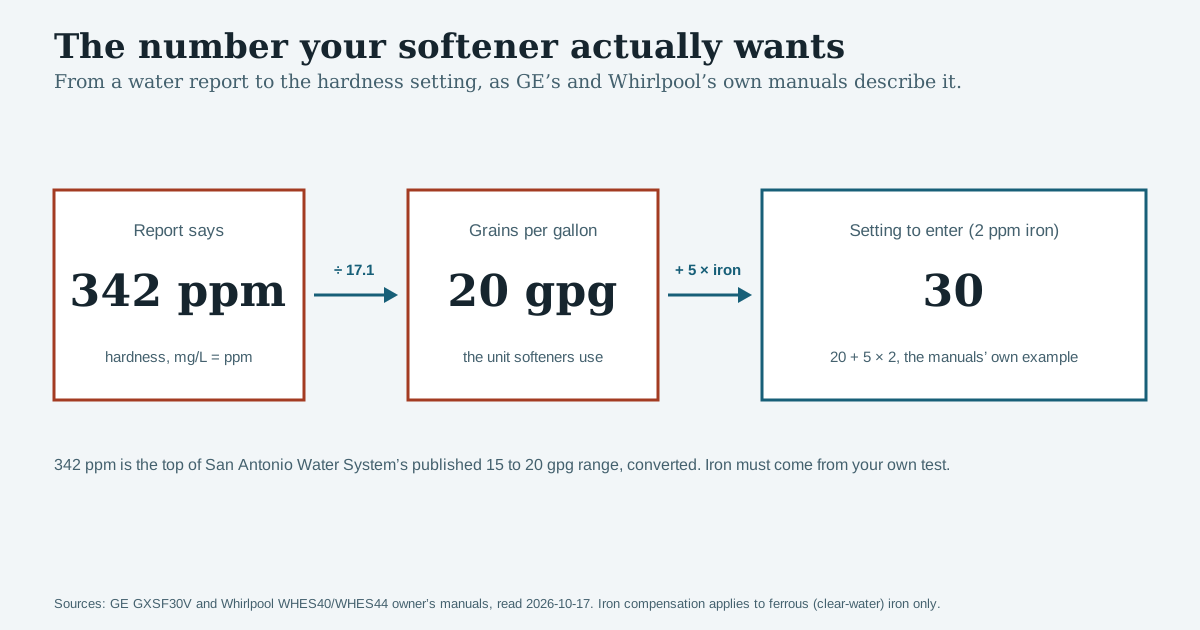
The water softener hardness setting is the number the controller uses to decide when to regenerate, and it should be your water's total hardness in grains per gallon, plus 5 for every 1 ppm of clear-water iron. If your water report gives hardness in ppm or mg/L, divide by 17.1 first. That is the instruction printed in GE's softener manual, and the iron rule is the same in GE's and Whirlpool's manuals: 20 grains of hardness with 2 ppm of iron is a setting of 30.
Getting the number in is easy. Choosing it is where most softeners end up mis-set: a factory default left in place, a ppm figure typed as grains, the average of a wide range, or an iron allowance nobody measured. This guide covers where the number comes from, how to treat a published range, what a wrong setting looks like in practice, and the settings around it that also affect how the softener behaves.
What the hardness setting actually does
A demand-initiated softener counts the water that passes through it. Multiply gallons by the hardness setting and you get grains of hardness removed; when that total approaches the capacity of the resin, the controller schedules a regeneration. Both the GE GXSF30V and the Whirlpool WHES40/WHES44 manuals describe their units as having demand-initiated regeneration, and Whirlpool's adds that the controls select the salt dose at regeneration time based on the amount needed.
So the setting does not change how soft the water is. It changes when the softener regenerates. The arithmetic is the same as in how often should a water softener regenerate: capacity divided by gallons times hardness gives days between regenerations. A setting that is wrong by half makes the regeneration interval wrong by half.
The water softener hardness setting, step by step
- Find your total hardness. From your utility's water quality report or water-quality page, or from a test at your tap. On a private well there is no utility figure, so a test is the only source; municipal water hardness vs well water explains why.
- Check the unit. Softeners take grains per gallon. The GE manual: "If your report shows hardness in parts per million (ppm) or milligrams per liter (mg/l), simply divide by 17.1 to get the equivalent number of grains per gallon." A figure in ppb must be divided by 1,000 first.
- Decide which figure to use if your source gives a range. See the section below.
- Add iron compensation if you have measured clear-water iron: plus 5 per ppm.
- Enter the result with the controller's up and down buttons. Whirlpool's manual: "Press the UP or DOWN buttons to set your water's hardness number."
Settings for ten US water systems
Here is step 2 done for every water system on this site, using each utility's own published figures. Where a utility published its own grain figure, that is shown; otherwise the conversion at 17.1 is ours. None of these includes iron, because none of these utilities publishes an iron figure for use at a tap.
| System | Published | Average or midpoint, gpg | Top of published range, gpg |
|---|---|---|---|
| Portland, Bull Run | 7 to 11 ppm | 0.5 (published) | 0.6 |
| MWRA, Boston | about 16 mg/L | 1 (published) | single value |
| Manchester, NH, 2022 | 17.88 ppm, 16.7 to 18.8 | 1.0 | 1.1 |
| NYC DEP | 32 mg/L, 18 to 100 | 2 (published) | 6 (published) |
| Austin Water | 93 ppm, 70 to 126 | 5.4 (published) | 7.4 (published) |
| Denver Water | 105,009 ppb, 55,000 to 124,000 | 6.1 | 7.3 |
| Phoenix | 172 to 302 ppm | 13.8 (midpoint) | 17.6 (published) |
| LVVWD, Las Vegas | 280 ppm | 16 (published) | single value |
| SAWS, San Antonio | 15 to 20 gpg | 17.5 (midpoint) | 20 (published) |
| Indianapolis | 317 ppm, 148 to 460 | 19 (published) | 27 (published) |
Look at the gap between the two right-hand columns. For Manchester, Portland and Boston it is negligible, and there is little hardness to remove in any case. For Indianapolis it is 8 grains, a difference of more than 40% in the setting. Which column to use is the real decision.
Average, top of the range, or a tap test?
A utility's figure describes its whole system over its sampling period. When the published range is narrow, the average is a fine setting. When it is wide, the average describes no particular tap, and the consequences of being wrong are lopsided.
If your setting is too high, the softener regenerates sooner than necessary. The water is still soft; you spend a little more salt and send more water to the drain.
If your setting is too low, the softener regenerates late. The resin runs out before the next regeneration and hard water comes through for the rest of the cycle.
Because the cost of erring high is salt and the cost of erring low is hard water, the top of a wide published range is the safer setting when you have nothing better. Better still is a test at your own tap, which replaces a system-wide range with your water. If you test with strips, remember that they read in bands: LaMotte's low range hardness strips, for example, read at 0, 30, 60, 120 and 180 ppm. A strip matching the 180 ppm block puts you somewhere around 10.5 grains per gallon, which is enough to choose a setting but worth confirming with a finer test if your water is near a block edge.
Seasonal variation is a reason to lean high, too. Denver Water's quarterly results run from 3.2 to 7.3 grains per gallon converted. A setting at 7 means slightly early regenerations in the softer quarters and never a shortfall in the harder ones. The University of Minnesota Water Resources Center notes that softeners with hardness sensors are best suited to areas where hardness fluctuates.
A worked example from report to keypad
San Antonio Water System publishes its hardness only in grains per gallon: "The typical hardness in the water provided by SAWS ranges from 15 to 20 gpg." Suppose a household in its service area has had its own water tested for iron and found 2 ppm of clear-water iron.
- Unit. Already grains per gallon, so no conversion. (The same figures in mg/L are 256.5 to 342, which is how they would appear if you used the hardness converter the other way.)
- Which figure. The range is 15 to 20. With no tap test for hardness, use the top: 20.
- Iron. 2 ppm × 5 = 10.
- Setting. 20 + 10 = 30.
That is the manuals' own worked example, arrived at from a real published figure. Had the household used the midpoint, 17.5, and skipped the iron, the setting would be 17.5, and on water at the top of the range with that much iron the softener would wait about 70% longer between regenerations than the load allows. Had it left a factory default of 25 in place, it would be closer by accident, which is not a method anyone should rely on.
Now the same steps for Austin, with no iron: the published range is 4.1 to 7.4 gpg as printed by the utility, so the top-of-range setting is 7.4, or about 7. That is right at the 7.0 grain level Penn State Extension describes as the point below which water "will probably not cause major scaling and soap film", which is a reasonable moment to ask whether softening is needed at all.
Iron compensation, done properly
Clear-water (ferrous) iron is taken up by the resin like hardness and uses capacity. Both the GE and the Whirlpool manual say to add 5 to the hardness number for each 1 ppm of iron. Their worked example is the same: 20 grains per gallon with 2 ppm iron becomes a setting of 30.
| Hardness (gpg) | Iron (ppm) | Setting |
|---|---|---|
| 10 | 0 | 10 |
| 10 | 1 | 15 |
| 20 | 2 | 30 |
| 16 | 0.5 | 18.5 |
Three cautions. First, the iron figure must come from a test of your water. Public utilities rarely publish iron at a level relevant to a softener, and none of the ten on this site does. Adding iron compensation for iron you do not have is simply a setting that is too high. Second, the manuals set limits: Whirlpool lists a maximum clear-water iron of 10 ppm for the WHES40 and 12 ppm for the WHES44. Third, the compensation is for clear-water iron only. Penn State Extension notes that red, oxidised iron clogs resin rather than being exchanged, and the University of Minnesota Water Resources Center suggests considering a separate iron filter above 3 ppm. It also notes that iron removal uses about four times more sodium than removing hardness ions.
Defaults and the mistakes that follow
Leaving the factory default. Whirlpool's manual gives a display default of 25. On Las Vegas water at 16 gpg, that tells the controller the water is about 56% harder than it is, and the unit regenerates roughly half again as often as it needs to. On Portland water at half a grain, a default of 25 makes a softener that barely has anything to do regenerate as if it were in Indianapolis.
Typing ppm as grains. Las Vegas publishes 280 ppm and 16 gpg side by side. Entering 280 tells the controller the water is seventeen times harder than it is. Most controls would accept it, since the WHES40's stated maximum hardness is 125 gpg and the WHES44's is 140, so the mistake may not be caught; it would just regenerate constantly.
Typing ppb. Denver's average is published as 105,009 ppb. That is 105.009 mg/L, which is 6.1 gpg. Anything else is a unit error.
Using the average of a wide range. See above. Indianapolis's 19 is not wrong, but it is not your tap.
Never revisiting it. Utilities change sources, and households change size. Manchester Water Works began drawing on the Merrimack River in August 2023, after the 2022 report that carries its published hardness, which is why this site flags that figure for re-checking. The University of Minnesota Water Resources Center suggests a professional check every two to five years and when family size changes.
The settings around the hardness number
Most controllers ask for more than hardness. These are the ones in the manuals read for this guide.
Time of day. Both GE and Whirlpool default to 2:00 AM, which Whirlpool describes as "a good time for the recharge to start in most households".
Salt type. Whirlpool's controller has an NaCl/KCl setting. Potassium chloride is an option for people on a sodium-restricted diet; the manual says the salt tank should contain no more than 60 pounds of KCl at any one time. The University of Minnesota Water Resources Center says potassium chloride is 15 to 30% less efficient than sodium chloride and three to five times more expensive.
Salt efficiency mode. GE and Whirlpool both offer one that operates at 4,000 grains of hardness removed per pound of salt or higher. GE's ships switched off; Whirlpool's manual says that in California the feature must be on.
Maximum days between regenerations. Whirlpool's is adjustable from 1 to 15 days and the manual recommends automatic mode.
Blending, where fitted. Some installations include a valve that lets a little hard water past the softener. The University of Minnesota Water Resources Center says a blending valve raises hardness from zero to usually about 2 grains per gallon, and that hardness of less than 5 to 7 grains per gallon may be acceptable to many homeowners. A blending valve does not change the hardness setting; the setting still describes the water coming in.
When the setting matters least
If your water is soft to begin with, the setting is close to irrelevant, because there may be no reason for a softener at all. Penn State Extension says hardness below 7.0 grains per gallon "will probably not cause major scaling and soap film". Four of the ten systems above publish figures at or below about 2 grains on average. The setting matters most in the very hard systems, where a few grains either way change the regeneration interval by days. If you are deciding whether to soften at all, what size water softener do I need covers that question first, and the hardness converter will turn any published figure into grains.
Sources and further reading
Setting instructions, iron compensation, defaults, limits and salt settings: the GE GXSF30V owner's manual and the Whirlpool WHES40/WHES44 owner's manual. Hardness thresholds and iron: Penn State Extension, Water Softening. Blending, sensors, potassium chloride and check intervals: University of Minnesota Water Resources Center, Residential softening. Strip readings: LaMotte Hardness Low Range Test Strips. All read 17 October 2026. Utility figures are each utility's own, with retrieval dates on their pages here. Nothing here was tested by WaterProfile Local.
The right water softener hardness setting is your total hardness in grains per gallon plus 5 per ppm of measured iron — taken from the top of a wide published range, or better, from your own tap.
Frequently asked questions
What should I set my water softener hardness to?
Your water's total hardness in grains per gallon, plus 5 for each ppm of clear-water iron. If your report gives ppm or mg/L, divide by 17.1, which is the instruction in GE's softener manual. Austin Water's published 93 ppm average, for example, is 5.4 grains per gallon.
What happens if the hardness setting is too high?
The softener regenerates more often than it needs to, using more salt and sending more water to the drain. The water is not over-softened; ion exchange cannot remove more hardness than is there. Whirlpool's display defaults to 25, so a unit left on the default on 16 gpg water regenerates roughly half again as often as necessary.
What happens if the hardness setting is too low?
The softener waits too long between regenerations, the resin runs out of capacity, and hard water comes through until the next regeneration. That usually shows up as spotting or scale returning a few days into each cycle.
Should I set the hardness to my utility's average or the top of its range?
If the range is narrow, the average is fine. If it is wide, the top of the range is safer, because a setting below your actual water lets hard water through. Indianapolis publishes 8.7 to 27 grains per gallon system-wide, and a setting at the 19 grain average would be well short for an address on water near 27. A test at your tap settles it.
How do I set iron compensation on a water softener?
The GE GXSF30V and Whirlpool WHES40/WHES44 manuals both say to add 5 to the hardness number for each 1 ppm of clear-water (ferrous) iron. Their example: 20 gpg hardness with 2 ppm iron gives a setting of 30. Use an iron figure from a test of your water, not a guess.