How Often Should a Water Softener Regenerate?
How often should a water softener regenerate? Capacity ÷ (gallons × hardness) gives days per cycle. Worked for four US cities, with timer vs demand units.
How often should a water softener regenerate? Exactly as often as your water use fills its capacity: divide the grains the softener delivers per cycle by the grains you use per day, and the answer is the number of days between regenerations. Grains per day is gallons per day times hardness in grains per gallon. So a softener delivering 25,300 grains per cycle, in a house using 300 gallons a day of 16 grain-per-gallon water, regenerates about every 5.3 days.
That is the right frequency in principle. In practice the frequency you see depends on how the softener decides to regenerate, what hardness it has been told the water is, and what salt dose it has been set to. This guide works the arithmetic for four real US water systems, explains timer versus demand-initiated control, and lists what makes a softener regenerate more often than it should.
The regeneration arithmetic
| Step | Formula | Example |
|---|---|---|
| 1. Daily gallons | people × gallons per person per day | 4 × 75 = 300 |
| 2. Grains per day | daily gallons × hardness (gpg) | 300 × 16 = 4,800 |
| 3. Days per cycle | grains per cycle ÷ grains per day | 25,300 ÷ 4,800 = 5.3 |
Step 3 is the sizing calculation turned around. Sizing asks how big a unit you need for a chosen number of days; regeneration frequency asks how many days a given unit lasts. The grain capacity calculator does the forward version, and dividing its capacity answer by grains per day gives this one.
The 75 gallons per person per day is the sample figure Penn State Extension uses and the labelled default in this site's calculator. It is an assumption, not a fact about your house. Your water bill is the better source.
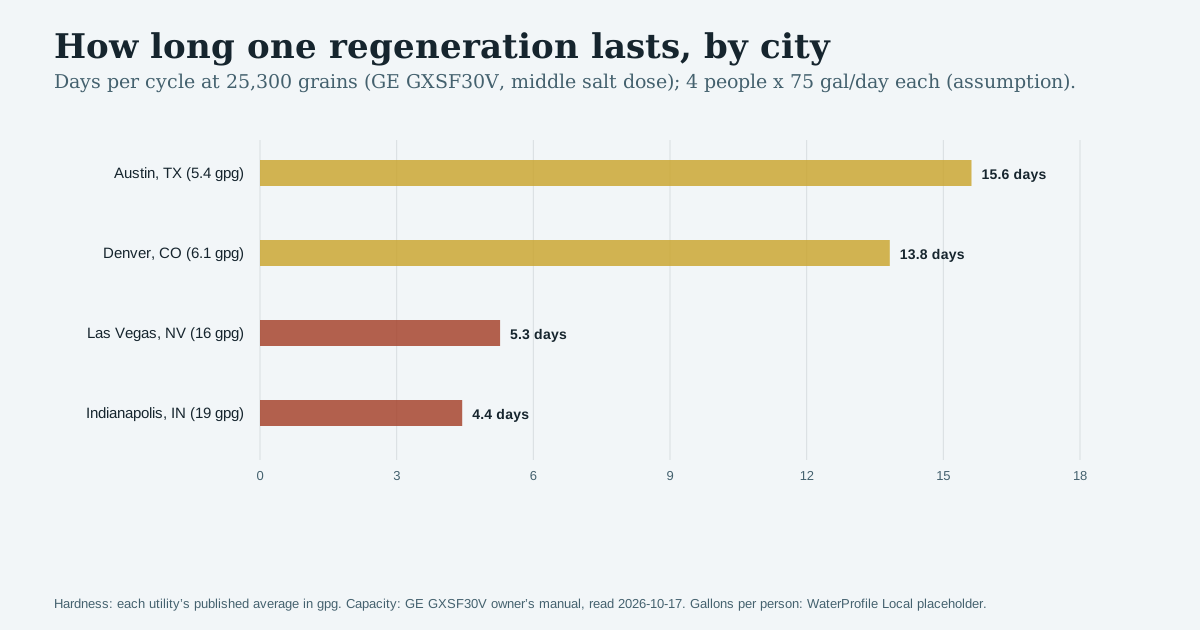
How often should a water softener regenerate in four US cities?
The table uses the GE GXSF30V's middle rated capacity, 25,300 grains at 7.9 lb of salt, from its owner's manual, for the same four-person, 300-gallon household in each city. The hardness is each utility's own published average.
| System | Published average | Grains per day | Days per cycle at 25,300 grains | Regenerations per 30 days |
|---|---|---|---|---|
| Austin Water | 5.4 gpg | 1,620 | 15.6 | about 2 |
| Denver Water | 6.1 gpg | 1,830 | 13.8 | about 2 |
| LVVWD, Las Vegas | 16 gpg | 4,800 | 5.3 | about 6 |
| Citizens Energy Group, Indianapolis | 19 gpg | 5,700 | 4.4 | about 7 |
Same unit, same household, same salt setting: one regenerates about twice a month and another about seven times. Hardness drives the frequency more than anything else.
Two of those cycles, Austin's and Denver's, run to roughly two weeks. Whirlpool's WHES40 and WHES44 manual allows a maximum of 1 to 15 days between recharges to be set, and recommends leaving the unit in automatic mode. A unit that has reached its maximum-days setting regenerates whether or not its capacity is used up, so if your unit regenerates more often than the arithmetic says on soft-ish water, check that setting before anything else.
The salt dose changes the answer
Manufacturers rate one softener at several salt doses, and the capacity per cycle changes a lot between them. Here is the same Las Vegas household, 4,800 grains a day, on each rated dose of the two units whose manuals were read for this guide.
| Unit and dose | Grains per cycle | Days per cycle | Grains per lb of salt |
|---|---|---|---|
| GE GXSF30V, 2.5 lb | 11,900 | 2.5 | about 4,760 (rated 4,770) |
| GE GXSF30V, 7.9 lb | 25,300 | 5.3 | about 3,203 |
| GE GXSF30V, 13.3 lb | 30,100 | 6.3 | about 2,263 |
| Whirlpool WHES40, 2.4 lb | 11,900 | 2.5 | rated 4,958 |
| Whirlpool WHES40, 9.0 lb | 31,600 | 6.6 | about 3,511 |
| Whirlpool WHES40, 15.5 lb | 40,000 | 8.3 | about 2,581 |
Grains per pound are our division of the manual figures, except where the manual states a rated efficiency. GE's manual is explicit that its efficiency rating "is valid only at the lowest stated salt dosage".
The trade-off is plain. The lowest dose regenerates most often and uses salt most efficiently. The highest dose regenerates least often and uses salt least efficiently. Nearly quadrupling the WHES40's salt from 2.4 to 9.0 lb raises its capacity only about 2.7 times, and the step from 9.0 to 15.5 lb adds only about a quarter more. If the goal is less salt, more frequent regeneration at a low dose is the efficient way to run a softener. The University of Minnesota Water Resources Center recommends an efficiency of 4,000 grains per pound or higher, and both GE and Whirlpool offer a salt efficiency mode that operates at 4,000 or better.
Timer versus demand-initiated regeneration
How a softener decides when to regenerate matters more to salt use than the frequency arithmetic.
Timer (time-clock) units regenerate on a fixed schedule. Penn State Extension says they "will waste more water and salt because they regenerate whether the resin needs it or not". If your household uses less water one week, a timer unit regenerates anyway. If it uses more, a timer unit can run out of capacity before its next scheduled regeneration and pass hard water.
Demand-initiated units meter the water and regenerate when the capacity is nearly used. Penn State says they usually regenerate after a set number of gallons are softened and suit households whose use fluctuates. GE and Whirlpool both describe their units as having demand-initiated regeneration (D.I.R.), with the salt dose selected by the electronic controls at regeneration time based on the amount needed, per Whirlpool's manual.
The University of Minnesota Water Resources Center quantifies the difference: demand-initiated softeners use 26 to 60% less salt and 25 to 40% less water than time-clock softeners. It also lists further savings from twin-tank units and from counter-current regeneration.
If you have a timer unit, the arithmetic above is how to set it. Work out days per cycle for your household, round down rather than up, and set the timer to that interval. Round down because the cost of running out is hard water at the tap, and the cost of regenerating a day early is a little salt.
What time of day
Regeneration is scheduled for an hour when nobody is using water, and both manuals read for this guide default to the middle of the night. GE's and Whirlpool's manuals both ship with a 2:00 AM default, and Whirlpool describes it as "a good time for the recharge to start in most households". Shift workers or households that run laundry or dishwashers overnight should move it to their own quietest hour.
Why a softener regenerates too often
When a softener regenerates noticeably more often than the arithmetic predicts, one of these is usually the cause. They are in the order worth checking.
The hardness setting is higher than your water. The controller divides capacity by what it believes the hardness is. If it was left at a factory default — Whirlpool's manual gives 25 as the display default — on 16 gpg water, it regenerates roughly half again as often as it needs to. How to set the hardness on a water softener walks through finding the right number.
Iron compensation is set when there is little iron, or the iron figure is high. Both GE and Whirlpool tell you to add 5 to the hardness setting per 1 ppm of clear-water iron. That is correct when you have the iron, and an unnecessary 50% increase on 20 gpg water when you assume 2 ppm without testing.
Water use is higher than you think. A leaking toilet flapper or a running irrigation line through the softener raises daily gallons without anyone noticing. Penn State suggests that toilets and outside spigots can be bypassed, which removes them from the load entirely.
The timer interval is set short. On a time-clock unit, the frequency is whatever the timer says, regardless of use.
The maximum-days setting is short. Some controls force a regeneration after a set number of days whatever the capacity. Whirlpool's is adjustable from 1 to 15 days.
The unit is old. The University of Minnesota Water Resources Center says softeners become less efficient as they age, and that a chlorine concentration of 2 ppm can halve the life of resin beads. Resin that has lost capacity fills sooner.
Why a softener regenerates too rarely
The opposite problem shows up as hard water at the tap or scale returning: the softener is running out of capacity before it regenerates. The causes are the mirror image. A hardness setting below your actual water, a utility figure taken from the bottom of a wide range, a timer interval too long for the household, or a salt tank that has run empty or formed a crust so the brine is weak. If your utility publishes a range, check where in it your setting sits: Phoenix's published range, for example, runs from 10 to 17.6 grains per gallon, and a unit set to the bottom of that will run short on water near the top.
Working it out for your own house
The four-city table uses a placeholder household. Here is the same calculation with inputs you can get yourself, using a published range rather than an average.
Suppose you are in Phoenix, which publishes 172 to 302 ppm, or 10 to 17.6 grains per gallon as printed by the city. Your water bill shows 9,000 gallons over a 30-day period, so 300 gallons a day. Your softener is set to deliver 25,300 grains per cycle.
- At the bottom of the range, 10 gpg: 300 × 10 = 3,000 grains a day, so 25,300 ÷ 3,000 = 8.4 days per cycle.
- At the top, 17.6 gpg: 300 × 17.6 = 5,280 grains a day, so 25,300 ÷ 5,280 = 4.8 days per cycle.
On a demand-initiated unit, those two answers are simply what the controller will do, provided the hardness setting matches your water. On a timer unit, you have to pick one interval for the whole year, and the safe choice is the shorter one: a timer set to eight days on water that is actually 17.6 gpg runs out of capacity around day five and passes hard water for the rest of the cycle.
Two refinements make the answer better. Subtract water that does not pass through the softener: Penn State Extension suggests toilets, outside spigots and basement sinks can be bypassed, and irrigation is often plumbed before the softener anyway. And replace the published range with a test at your own tap, which turns two possible answers into one. If you are not sure which utility's figure applies to you at all, find your water system first.
Frequency and salt use go together
Regeneration frequency is half of the salt question. Pounds of salt per month are regenerations per month times the salt dose per regeneration. For the Las Vegas household above on the GE GXSF30V's middle setting, about 30 ÷ 5.3, or 5.7 regenerations a month at 7.9 lb each, is about 45 lb of salt a month. On the lowest setting, 30 ÷ 2.5 is 12 regenerations at 2.5 lb, about 30 lb. More regenerations, less salt — the efficiency table above in practice. These are arithmetic on manual figures, not measurements, and a demand-initiated unit's own controller adjusts the dose, so treat them as an illustration of the trade-off rather than a forecast of your salt bill.
Water and drain use per regeneration
Every regeneration sends water to the drain, and the frequency multiplies it. The GE GXSF30V manual lists 2.8 gallons per 1,000 grains at minimum salt dose and 35.5 gallons per regeneration at maximum dose. The Whirlpool manual lists 37.1 gallons for the WHES40 and 43.2 for the WHES44 at maximum dose. Penn State estimates about 50 gallons per regeneration as a general figure and notes that this may overload a septic drainage field, and the University of Minnesota Water Resources Center notes that a softener that is not set correctly may have a negative impact on a septic tank.
So a septic household has a specific reason to get the hardness setting right: every unnecessary regeneration is tens of gallons of brine into the system.
Sources and further reading
Timer versus demand-initiated, salt and water per regeneration, sizing sample: Penn State Extension, Water Softening. Efficiency and sizing guidance: University of Minnesota Water Resources Center, Residential softening. Ratings, default times, maximum days and drain volumes: the GE GXSF30V owner's manual and the Whirlpool WHES40/WHES44 owner's manual. All read 17 October 2026. Utility hardness figures are each utility's own, with retrieval dates on their pages here. Nothing in this guide was tested by WaterProfile Local.
How often should a water softener regenerate comes down to capacity divided by the grains you use each day — so the hardness you tell the controller is the setting that decides it.
Frequently asked questions
How often should a water softener regenerate?
As often as the hardness you use fills its capacity, and no more. Divide the grains it delivers per cycle by your daily gallons times your hardness in grains per gallon. A unit delivering 25,300 grains, serving 300 gallons a day of 16 gpg water, needs to regenerate about every 5.3 days. The University of Minnesota Water Resources Center recommends sizing so a softener works three to five days between regenerations.
Is it bad if my softener regenerates every day?
Not in itself, but daily regeneration usually means either a small unit for the load, a hardness setting higher than your water, or a timer set too short. Each regeneration uses salt and sends water to the drain: GE lists up to 35.5 gallons per regeneration for its GXSF30V at the maximum salt dose. Check the hardness setting first.
What time should a water softener regenerate?
At an hour when no one is using water. GE and Whirlpool both set a factory default of 2:00 AM, and Whirlpool's manual describes that as a good time for most households.
What is the difference between timer and demand-initiated regeneration?
A timer unit regenerates on a fixed schedule whether the resin needs it or not. A demand-initiated unit counts the water used and regenerates when the capacity is nearly used up. The University of Minnesota Water Resources Center says demand-initiated units use 26 to 60% less salt and 25 to 40% less water than time-clock softeners.
Can I make my softener regenerate less often?
Only by reducing the hardness it has to remove or raising the grains per cycle. Bypassing toilets and outside taps, as Penn State Extension suggests, cuts daily load. Raising the salt dose raises capacity but lowers efficiency: Whirlpool's WHES40 goes from 11,900 grains at 2.4 lb to 40,000 at 15.5 lb, or from about 4,958 to about 2,581 grains per pound of salt.