Water Hardness ppm to gpg: The Conversion, Explained
Water hardness ppm to gpg: divide ppm by 17.1. Here is the conversion table, where the 17.1 comes from, and the mistakes that produce wrong answers.
Water hardness ppm to gpg is one division: divide the ppm figure by 17.1. So 171 ppm is 10 grains per gallon, 100 ppm is 5.8 gpg, and 317 ppm is 18.5 gpg. To reverse it, multiply grains per gallon by 17.1. That is the whole conversion, and everything below exists because the arithmetic is the easy part — knowing which number to put into it is where people go wrong.
The conversion table
Figures rounded to one decimal place, which is more precision than most utilities publish.
| ppm (mg/L) | Grains per gallon | USGS class |
|---|---|---|
| 10 | 0.6 | Soft |
| 20 | 1.2 | Soft |
| 30 | 1.8 | Soft |
| 50 | 2.9 | Soft |
| 60 | 3.5 | Soft, top of band |
| 75 | 4.4 | Moderately hard |
| 100 | 5.8 | Moderately hard |
| 120 | 7.0 | Moderately hard, top of band |
| 150 | 8.8 | Hard |
| 180 | 10.5 | Hard, top of band |
| 200 | 11.7 | Very hard |
| 250 | 14.6 | Very hard |
| 300 | 17.5 | Very hard |
| 400 | 23.4 | Very hard |
| 500 | 29.2 | Very hard |
And the same relationships as formulas, for the two units plus the two European ones you will meet on imported appliance documentation:
| From | To | Formula |
|---|---|---|
| ppm or mg/L | gpg | gpg = ppm ÷ 17.1 |
| gpg | ppm or mg/L | ppm = gpg × 17.1 |
| ppm or mg/L | German degrees (°dH) | °dH = ppm ÷ 17.848 |
| ppm or mg/L | French degrees (°f) | °f = ppm ÷ 10 |
| ppb or µg/L | mg/L | mg/L = ppb ÷ 1000 |
The converter on this site does all of these in both directions and prints the arithmetic rather than just the answer.
Where the 17.1 actually comes from
A grain is a real unit of mass, not a water-industry invention. It is 1/7000 of a pound, a survival from pre-metric weight systems where it described the mass of a grain of cereal. One grain per gallon therefore means one 7000th of a pound of dissolved hardness minerals in each US gallon of water.
To convert that into milligrams per litre you need the mass of a US gallon of water. A US gallon is 3.785 litres and weighs about 8.345 pounds. So one grain per gallon is one 7000th of 8.345 pounds, spread through 3.785 litres, which works out at roughly 17.1 milligrams per litre.
Different references round the last step differently and you will see 17.1, 17.12 and 17.118 in circulation. The spread between them is about a tenth of a percent, which is far below the precision any water utility publishes. Austin Water's own report states the factor as about 17.1 ppm per gpg, and that is the figure this site uses everywhere so that every number on it can be reproduced with a pocket calculator.
One more definitional point, because it trips people up constantly: hardness is reported as calcium carbonate. The actual minerals in your water are calcium and magnesium in various compounds, but reporting them all as an equivalent mass of CaCO₃ gives one number that can be compared between systems. So a conversion between ppm and gpg is not a chemistry calculation at all. It is a unit change on a quantity that has already been standardised.
Real figures, converted
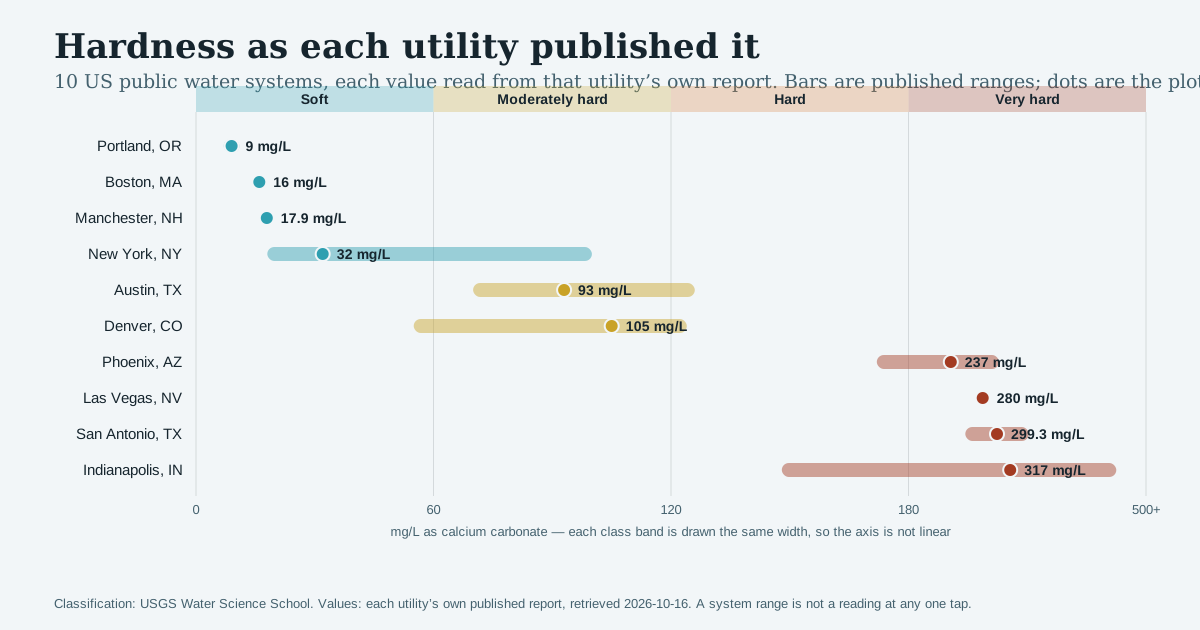
These are the published hardness figures from ten US public water systems, each read from that utility's own report. They are useful here because they show what the conversion looks like on numbers nobody chose to make the arithmetic tidy.
| Utility | Published | In the other unit | USGS class |
|---|---|---|---|
| Portland Water Bureau, Bull Run supply | 7 to 11 ppm | 0.4 to 0.6 gpg | Soft |
| MWRA, Boston | 16 mg/L, stated with 1 gpg | — | Soft |
| Manchester Water Works, 2022 | 17.88 ppm average | 1.0 gpg | Soft |
| NYC DEP | 32 mg/L average, range 18 to 100 | 1.9 gpg average | Soft |
| Austin Water | 93 ppm average, stated with 5.4 gpg | — | Moderately hard |
| Denver Water | 105,009 ppb average | 105.009 mg/L, 6.1 gpg | Moderately hard |
| Phoenix Water Services | 172 to 302 ppm, stated with 10 to 17.6 gpg | — | Very hard |
| LVVWD, Las Vegas | 280 ppm average, stated with 16 gpg | 16.4 gpg at 17.1 | Very hard |
| SAWS, San Antonio | 15 to 20 gpg typical | 256.5 to 342 mg/L | Very hard |
| Citizens Energy Group, Indianapolis | 317 ppm average, range 148 to 460 | 18.5 gpg average, 8.7 to 27 range | Very hard |
Three things in that table are worth more attention than the conversions themselves.
The first is Las Vegas. The district publishes both 280 ppm and 16 gpg. But 280 divided by 17.1 is 16.4, not 16. The utility has rounded to whole grains, which is entirely reasonable for a public summary and slightly wrong as arithmetic. When a utility publishes both units, use its own figures and treat any disagreement with your calculator as rounding rather than error — but know that it is there.
The second is Denver. Hardness published in parts per billion is unusual but not unique, and 105,009 is a number that looks like a typo until you read the unit column. Converted properly it is 105.009 mg/L, a thoroughly ordinary moderately hard figure. Converted carelessly, treating ppb as ppm, it becomes 6,140 gpg, which would be the hardest water ever recorded anywhere.
The third is Indianapolis, and it is the one that matters for anyone about to spend money. Citizens Energy Group publishes an average of 317 ppm and a system-wide range of 148 to 460 ppm. Converted, that is an average of 18.5 gpg against a range of 8.7 to 27 gpg. Those two ends of the range produce softener sizing requirements that differ threefold. The conversion is trivial; choosing which of those three numbers to feed into it is the actual decision.
The mistakes that produce wrong answers
Converting a ppb figure as if it were ppm. A thousandfold error, and the easiest one to make because the number itself gives no clue. Always read the unit column before the value column.
Treating a system range as a single value. A range is the utility telling you that its own water varies. Collapsing 148 to 460 into "317" throws away the most honest thing in the report.
Using the imperial gallon by mistake. An imperial gallon is about 4.546 litres, so a grain per imperial gallon works out near 14.3 mg/L, not 17.1. US water-quality reports and US softener documentation use US gallons throughout. A figure from a UK source in "grains per gallon" may be on the other definition.
Mixing up °dH with gpg. Both are small whole-ish numbers for ordinary water, so 10 °dH and 10 gpg look interchangeable and are not: 10 °dH is 178 mg/L while 10 gpg is 171 mg/L. The gap is small for a single conversion and grows if you convert back and forth.
Assuming a utility figure describes your tap. It does not, and no conversion fixes that. The published figure describes water in the utility's system at its sampling points. Your service line, your building's plumbing and any treatment already installed all sit downstream of it.
Carrying false precision. If a report says 93 ppm, the honest conversion is 5.4 gpg. Writing 5.4386 implies a measurement nobody made.
Which direction you will need
In practice the two directions serve different jobs.
ppm to gpg is the direction you need when you have a water-quality report and you are about to buy or set up equipment. Reports are written in ppm or mg/L because that is the convention for water chemistry. Softener controllers, resin capacity ratings and dishwasher hardness settings are specified in grains per gallon because that is the convention in American plumbing. So the conversion is the bridge between the document you were sent and the dial you have to set.
gpg to ppm is the direction you need when someone has told you a hardness figure in grains and you want to compare it against a classification, a published utility value, or an international specification. The USGS bands are defined in mg/L. Appliance documentation from Europe is in °dH or °f. Both comparisons go through mg/L.
Grains per gallon and softener capacity
Grains per gallon exists as a unit mainly because of water softeners, and the connection is more direct than most people realise. A softener's capacity is rated in grains: a 32,000 grain unit removes 32,000 grains of hardness before it has to regenerate. Since hardness in gpg is grains per gallon of water, multiplying gpg by the gallons you use gives grains consumed, and the units cancel cleanly.
That is why the sizing arithmetic is multiplication rather than anything more exotic. Household gallons per day, times hardness in gpg, times days between regenerations, gives the grains one cycle has to carry. The grain capacity calculator runs exactly that, with every assumption shown as an editable field rather than buried.
It also explains why the conversion matters more here than in most unit problems. Put a ppm figure into a grains calculation by mistake and you will size a unit seventeen times too large. The error is big enough to be obvious if you are paying attention and quiet enough to slip through if you are not.
Why one system gives different numbers in different months
A conversion is exact, but the figure you are converting usually is not a constant, and knowing why protects you from over-reading a precise-looking answer.
Denver Water samples hardness quarterly and publishes a range of 55,000 to 124,000 ppb against its average of 105,009, which is 3.2 to 7.3 gpg against an average of 6.1. Its own water-quality page explains the spread: the water is slightly harder in winter, when waterways and reservoirs freeze, and softer from late spring through autumn, when snowmelt runoff dilutes the minerals. The same system therefore crosses from soft into moderately hard across a single year.
Portland is the starker case. Its main Bull Run supply is published at 7 to 11 ppm, about half a grain per gallon, while the city's groundwater supply is published at about 80 ppm, about 5 grains. Which supply reaches an address changes, so no single converted figure describes that tap all year.
So convert the number you have, then ask what period it covers. An annual average converted to one decimal place can still be a poor description of the water in February.
The classification in both units
The USGS publishes its hardness classification in mg/L as calcium carbonate. Converted at 17.1, the same bands in grains per gallon look like this.
| Class | USGS wording (mg/L) | In grains per gallon |
|---|---|---|
| Soft | 0 to 60 | 0 to 3.5 |
| Moderately hard | 61 to 120 | 3.6 to 7.0 |
| Hard | 121 to 180 | 7.1 to 10.5 |
| Very hard | more than 180 | more than 10.5 |
Treat the gpg column as derived rather than official, because the classification is defined in mg/L and the grain figures are a conversion of it. And treat the whole classification as one body's convention rather than a universal standard. New York City's 2025 report footnotes hardness up to 3 grains per gallon as soft and 3 to 9 as moderately hard, which does not line up with the USGS bands converted. Neither is wrong; they are different conventions, which is a good reason to quote the number alongside any class name you use.
A worked example, end to end
Suppose your report shows a total hardness average of 220 mg/L with a range of 180 to 260.
Convert the average: 220 divided by 17.1 is 12.9 gpg. Convert the range ends: 180 divided by 17.1 is 10.5, and 260 divided by 17.1 is 15.2. So you have 12.9 gpg typical, with a plausible span of 10.5 to 15.2 gpg.
Classify it: 220 mg/L is above 180, so it is very hard on the USGS scale, and so is the whole range.
Then decide what to use. For a dishwasher hardness setting, 13 gpg is fine; the setting is coarse. For a softener, the choice between 10.5 and 15.2 changes the capacity you need by almost half again, so either size for the top of the range or get a tap test. The conversion took ten seconds. The judgement about which end of the range to trust is the part worth spending time on.
Sources and further reading
The hardness classification bands quoted here come from the USGS Water Science School, retrieved 16 October 2026. The utility figures come from each utility's own published report: Austin Water, Citizens Energy Group, MWRA, Denver Water and the rest, each cited with its report year and retrieval date on its own page here. The methodology page lists every source and every assumption, and how to read a water quality report covers finding the hardness line in the first place.
Converting water hardness ppm to gpg takes one division by 17.1, and if you remember nothing else from this guide, remember to check the unit column and the column heading before you divide — because the arithmetic is never the thing that goes wrong.
Frequently asked questions
How do I convert water hardness from ppm to gpg?
Divide the ppm figure by 17.1. A report showing 171 ppm is 10 grains per gallon. To go the other way, multiply grains per gallon by 17.1. The factor is fixed, so the conversion is exact arithmetic and introduces no uncertainty beyond rounding.
Is ppm the same as mg/L for water hardness?
Yes, for drinking water. One part per million is one milligram per litre in a dilute water solution, and water-quality reports use the two labels interchangeably. Austin Water's report writes the unit as 'ppm (mg/L)' for exactly this reason, so you can treat a ppm figure and an mg/L figure as the same number.
Why is the conversion factor 17.1 and not 17.12 or 17.118?
One grain is 1/7000 of a pound and a US gallon of water weighs about 8.345 pounds, which gives roughly 17.1 milligrams per litre per grain. Different references round the result to 17.1, 17.12 or 17.118. The differences are below the precision any utility publishes, so 17.1 is the sensible working figure, and it is the factor Austin Water prints in its own report.
What counts as hard water in grains per gallon?
Applying the USGS classification, which is defined in mg/L, the bands work out to about 3.5 gpg for the top of soft, 7 gpg for the top of moderately hard, and 10.5 gpg for the top of hard, with anything above that very hard. Be aware that some utilities use different edges: New York City's own report calls up to 3 gpg soft and 3 to 9 gpg moderately hard.
My report shows hardness in ppb. What do I do?
Divide by 1,000 to get mg/L first, then divide by 17.1. Denver Water publishes a hardness average of 105,009 ppb, which is 105.009 mg/L, which is about 6.1 grains per gallon. Missing the ppb step produces an answer a thousand times too large, and it is the single most expensive misreading in this whole topic.
Should I use my utility's figure to size a water softener?
Use it as a starting point and know its limits. A utility figure describes its system over its sampling period, not the water at your tap, and plenty of systems publish wide ranges: Citizens Energy Group reports 8.7 to 27 grains per gallon across Indianapolis. If equipment depends on the answer, a test at your own tap is the figure to size from.