Calcium vs Magnesium Hardness: How Total Is Built
Calcium vs magnesium hardness: total hardness = 2.497 × calcium + 4.118 × magnesium, as CaCO3. Worked on Denver and Las Vegas figures, with the caveats.
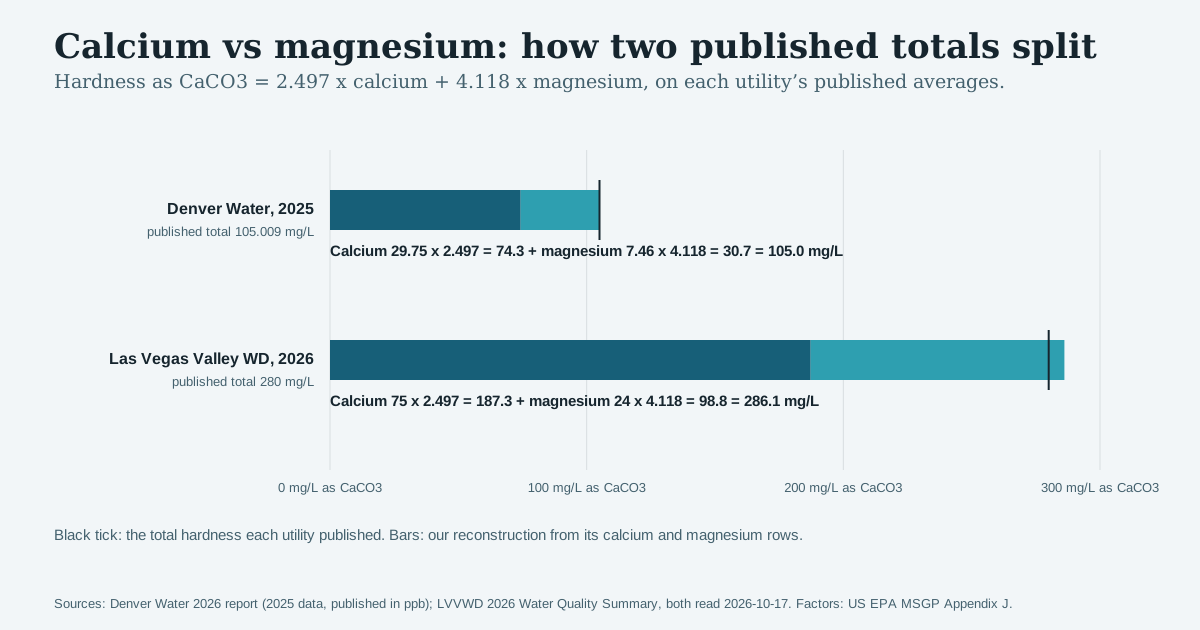
Calcium vs magnesium hardness is the split behind a single number. Total hardness is the combined effect of dissolved calcium and magnesium, and because the two elements have different atomic masses, each is converted to an equivalent amount of calcium carbonate before they are added. The formula used by the US EPA is hardness as CaCO₃ (mg/L) = 2.497 × calcium (mg/L) + 4.118 × magnesium (mg/L).
That formula is what lets a water report print one hardness figure for water whose calcium and magnesium vary independently. This guide explains where the two factors come from, rebuilds the published totals of two US utilities from their own calcium and magnesium rows, and covers when the split matters to you and when it does not.
Why there are two kinds of hardness at all
The USGS defines hardness as "the amount of dissolved calcium and magnesium in the water". Nebraska Extension calls them "the two most common minerals that make water hard". Both are picked up as water moves through soil and rock, and the ratio between them depends on the geology the water has passed through.
Both elements cause the same practical effects: scale when water is heated, and soap that forms curd instead of lather. Because they behave alike in those respects, it is convenient to have one number for both. But you cannot add milligrams of calcium to milligrams of magnesium and get a meaningful total, because the two are not equivalent mass for mass. The calcium carbonate convention is the fix: express each as the mass of calcium carbonate that would carry the same hardness, and then add.
Where 2.497 and 4.118 come from
Each factor is the ratio of calcium carbonate's equivalent weight to the element's equivalent weight. Both calcium and magnesium ions carry a charge of two, so hardness is really counted by the number of ions, not by their mass. Magnesium atoms are lighter than calcium atoms, so a milligram of magnesium contains more ions — more hardness — than a milligram of calcium.
In round numbers: calcium carbonate's molar mass is about 100, calcium's about 40 and magnesium's about 24.3. Dividing gives roughly 2.5 for calcium and 4.1 for magnesium. The precise published factors, 2.497 and 4.118, come from the precise atomic masses. The EPA's Multi-Sector General Permit, Appendix J, gives the formula as "mg/L CaCO3 = 2.497 (Ca mg/L) + 4.118 (Mg mg/L)", and the Safe Drinking Water Foundation's teaching material uses the same factors.
| Ion | Factor to CaCO₃ | 10 mg/L of the ion is equivalent to | In grains per gallon |
|---|---|---|---|
| Calcium | 2.497 | 24.97 mg/L as CaCO₃ | 1.46 |
| Magnesium | 4.118 | 41.18 mg/L as CaCO₃ | 2.41 |
So, mass for mass, magnesium contributes about 1.65 times as much hardness as calcium. That is why a report showing more milligrams of calcium than magnesium can still have magnesium contributing a substantial share of the total. The Safe Drinking Water Foundation makes the related point that "fluctuations in the magnesium pool affect hardness stronger than do calcium fluctuations".
Calcium vs magnesium hardness in two real reports
Most US utilities that publish hardness print only the total. A few also print calcium and magnesium as separate rows, which makes it possible to check the arithmetic against their own figures. Two systems on this site do.
Denver Water, 2025 data in its 2026 report, publishes calcium at an average of 29,750 ppb and magnesium at 7,460 ppb, both quarterly distribution-system samples. Divide by 1,000 for mg/L: 29.75 and 7.46.
Las Vegas Valley Water District, 2026 Water Quality Summary, publishes calcium at 75 ppm and magnesium at 24 ppm.
| Denver Water | LVVWD, Las Vegas | |
|---|---|---|
| Calcium, published | 29,750 ppb (29.75 mg/L) | 75 ppm |
| Calcium × 2.497 | 74.3 mg/L as CaCO₃ | 187.3 mg/L as CaCO₃ |
| Magnesium, published | 7,460 ppb (7.46 mg/L) | 24 ppm |
| Magnesium × 4.118 | 30.7 mg/L as CaCO₃ | 98.8 mg/L as CaCO₃ |
| Rebuilt total | 105.0 mg/L | 286.1 mg/L |
| Published total | 105,009 ppb (105.009 mg/L) | 280 ppm |
| Calcium share of rebuilt total | 71% | 65% |
| Magnesium share of rebuilt total | 29% | 35% |
Denver's rebuild matches its published total to within rounding. Las Vegas's comes out about 2% above the published figure, which is the normal result of averaging separate rows and rounding each to whole ppm. Neither is an error, and the published total is the one to quote. You can look at both utilities' full pages: Denver Water and Las Vegas Valley Water District.
The more interesting result is the shares. Calcium carries most of the hardness in both systems, but in Las Vegas magnesium accounts for over a third. Water drawn from different geology could tilt further either way; a split of two-thirds to one-third is what these two reports show, not a rule.
Ranges do not combine the same way
Both reports also publish ranges for calcium and magnesium, and it is tempting to rebuild a hardness range by combining the lowest calcium with the lowest magnesium, and the highest with the highest. For Denver, that gives:
- Low: 2.497 × 18.2 + 4.118 × 2.19 = 45.4 + 9.0 = 54.5 mg/L
- High: 2.497 × 36.0 + 4.118 × 10.14 = 89.9 + 41.8 = 131.6 mg/L
Denver's published hardness range is 55,000 to 124,000 ppb, or 55 to 124 mg/L. The low end matches almost exactly. The high end overshoots by about 8 mg/L, because the quarter with the most calcium was not necessarily the quarter with the most magnesium. Adding two maximums gives a combination that may never have occurred in one sample.
That is a general point worth carrying to any report: ranges of components do not add into a range of the total. Use the published hardness range where one exists, and treat any rebuilt range as an outer bound.
When the split matters to you
For most household decisions it does not, and it is useful to know why.
Water softeners: not for sizing. A softener's capacity is rated in grains of hardness as calcium carbonate, which already includes both ions. The GE GXSF30V and Whirlpool WHES40 owner's manuals both ask for total hardness in grains per gallon; GE's tells you to divide a ppm or mg/L figure by 17.1. Ion exchange removes both calcium and magnesium, so the grain capacity calculator and the sizing guide work on the total alone.
Appliance settings: no. Dishwasher and coffee-machine hardness settings are specified in total hardness — Bosch's in millimoles per litre, others in degrees or grains — and the Bosch dishwasher setting guide works from the total.
Scale: in principle, a little. Both ions contribute to scale, but the USGS describes household water heater scale as calcium carbonate specifically, which is why calcium hardness gets particular attention in some technical contexts. For a household, total hardness is the figure manufacturers' warranty and maintenance documents use, so it is the one to compare against them; hard water and water heaters covers that.
Diet: a small contribution, and not a hardness question. Nebraska Extension cites the National Research Council's view that hard drinking water "generally contributes a small amount of calcium and magnesium" to the diet. Penn State Extension describes the minerals as having no adverse health effects and as essential nutrients. Neither treats hardness as a health metric, and the EPA sets no standard for it. If a dietary question matters to you, the separate calcium and magnesium rows are the relevant figures, and the question belongs with a clinician, not a hardness scale.
What replaces calcium and magnesium when water is softened
An ion exchange softener takes calcium and magnesium out of the water and puts something else in. Penn State Extension describes the resin as holding sodium ions, which it releases as it takes up hardness. So after softening, the calcium and magnesium rows in your report no longer describe the water at your tap, and a sodium figure rises in their place.
The published estimates of how much sodium are close to each other. Penn State Extension says the exchange "adds 7.5 milligrams per quart for each gpg of hardness removed". Nebraska Extension, citing the Water Quality Association, puts it at about 8 mg/L for each grain per gallon removed, and gives an example: water at 10 grains per gallon, fully softened, would contain about 80 mg/L of sodium from the softener.
Applied to the two utilities above, using their published total hardness in grains per gallon and Nebraska's 8 mg/L per grain:
| Denver Water | LVVWD, Las Vegas | |
|---|---|---|
| Published hardness, gpg | 6.1 (converted from 105,009 ppb) | 16 |
| Sodium added if fully softened, approx. | 49 mg/L | 128 mg/L |
| Sodium already published in the water | 12.3 to 23.8 mg/L by treatment plant (averages) | 89 ppm average |
The added sodium does not depend on whether the hardness was mostly calcium or mostly magnesium. Ion exchange swaps by charge, and both ions carry the same charge, which is why the per-grain figure is a single number.
For context, the US EPA's 2003 drinking water advisory on sodium gives a guidance level of 20 mg/L, developed specifically for people restricted to a total sodium intake of 500 mg a day, and states that it should not be extrapolated to the whole population. Nebraska Extension notes that some people may be advised by their physician to avoid softened water for drinking and cooking, and a common arrangement is to leave one cold kitchen tap unsoftened. Whirlpool's softener manual also lists potassium chloride as an alternative regenerant for users on a sodium-restricted diet, though the University of Minnesota Water Resources Center notes that potassium chloride is 15 to 30% less efficient than sodium chloride.
Reading the separate rows in your report
If your report publishes calcium and magnesium, four checks make the rows useful.
- Read the unit. Denver publishes both in ppb. 29,750 ppb is 29.75 mg/L, not 29,750.
- Check whether the row is the element or a hardness. Some reports print "calcium hardness as CaCO₃" rather than "calcium". If the label says "as CaCO₃", the figure is already converted and must not be multiplied by 2.497 again.
- Rebuild the total and compare. A rebuild within a few percent of the published total confirms you have read the rows correctly. A rebuild two and a half times too high usually means the calcium row was already "as CaCO₃".
- Quote the published total. The rebuild is a check, not a replacement.
If your report gives only calcium and magnesium and no hardness line, the formula gives you a total you can classify on the USGS hardness scale and convert in the hardness converter. Say that it is calculated, not published, wherever you use it.
A worked example from scratch
Suppose a report lists calcium at 48 mg/L and magnesium at 12 mg/L, with no hardness line.
- Calcium hardness: 48 × 2.497 = 119.9 mg/L as CaCO₃
- Magnesium hardness: 12 × 4.118 = 49.4 mg/L as CaCO₃
- Total: 169.3 mg/L as CaCO₃
- In grains per gallon: 169.3 ÷ 17.1 = 9.9 gpg
- USGS class: hard (121 to 180 mg/L)
Calcium is 71% of the total here and magnesium 29%, close to Denver's split. Four times as many milligrams of calcium as magnesium still leaves magnesium with nearly a third of the hardness, which is the factor of 1.65 at work.
Sources and further reading
The formula: US EPA, Multi-Sector General Permit Appendix J, Calculating Hardness, and the Safe Drinking Water Foundation, Total Hardness Analysis. Definitions and health context: USGS Water Science School, Hardness of Water; Nebraska Extension, G1274; Penn State Extension, Water Softening. Utility rows: Denver Water 2026 report and LVVWD 2026 Water Quality Summary. Softener input and regenerants: the GE GXSF30V owner's manual, the Whirlpool WHES40/WHES44 owner's manual and the University of Minnesota Water Resources Center, Residential softening. Sodium guidance: US EPA, Drinking Water Advisory on Sodium (2003). All read 17 October 2026.
Calcium vs magnesium hardness comes down to two multiplications and an addition, and for nearly every household decision the total they add up to is the number that matters.
Frequently asked questions
What is the difference between calcium hardness and magnesium hardness?
They are the two parts of total hardness. Calcium hardness is the share caused by dissolved calcium, magnesium hardness the share caused by dissolved magnesium, each expressed as an equivalent amount of calcium carbonate so they can be added. In most water calcium is the larger share: in Denver Water's 2025 averages it is about 71% of the total.
How do I calculate total hardness from calcium and magnesium?
Use hardness as CaCO3 (mg/L) = 2.497 × calcium (mg/L) + 4.118 × magnesium (mg/L). That is the formula in the US EPA's Multi-Sector General Permit, Appendix J. For example, Denver Water's 2025 averages of 29.75 mg/L calcium and 7.46 mg/L magnesium give 74.3 + 30.7 = 105.0 mg/L.
Why is the magnesium factor bigger than the calcium factor?
Because a magnesium atom is lighter than a calcium atom but carries the same charge. A milligram of magnesium therefore represents more hardness than a milligram of calcium, and converting it to calcium carbonate equivalents multiplies it by more: 4.118 against 2.497.
Does it matter for a water softener whether hardness is calcium or magnesium?
For sizing, no. A softener's capacity is rated in grains of hardness as calcium carbonate, which already combines both. Enter the total hardness in grains per gallon, as the GE and Whirlpool owner's manuals describe, and the split does not change the calculation.
My calculated total does not match the published total. Which is right?
Use the utility's published total. Averages of separate samples do not have to add up exactly, rounding in the published calcium and magnesium figures compounds, and the two may come from different sample sets. Las Vegas's 2026 averages rebuild to 286.1 mg/L against a published 280, a gap of about 2%.