Bosch Dishwasher Water Hardness Setting: H:00 to H:07
Bosch dishwasher water hardness setting, from your utility's figure: up to 110 mg/L is H:00 (no salt). Full US table, steps, and 10 real utilities.
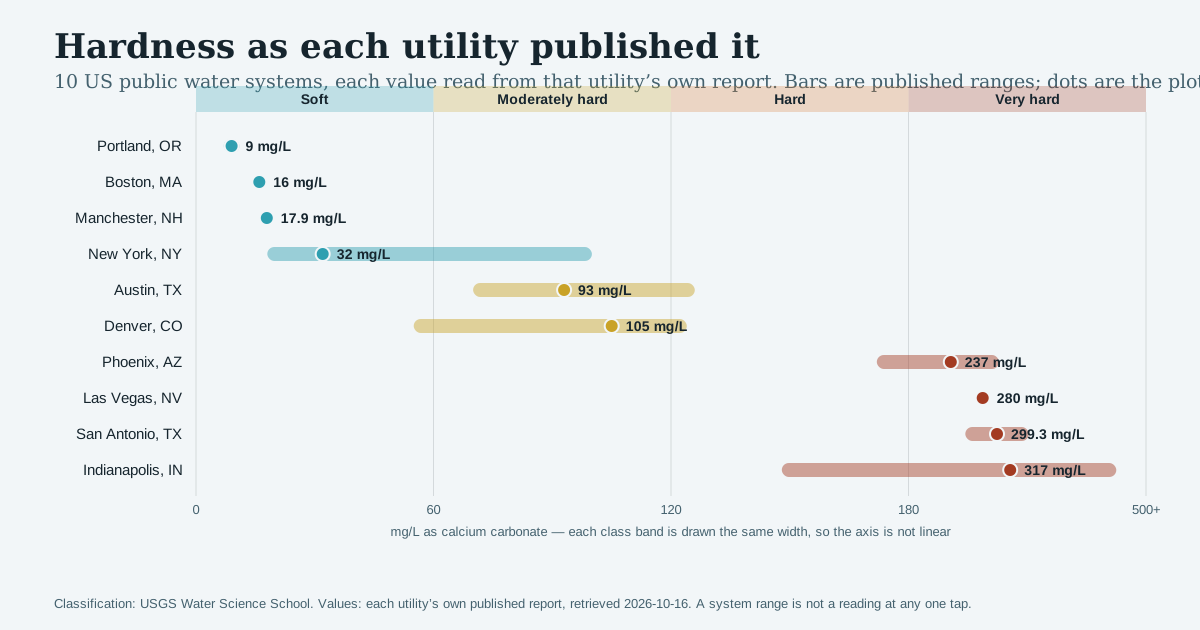
The Bosch dishwasher water hardness setting runs from H:00 to H:07, and you choose it from your water's hardness: up to about 110 mg/L (6.4 grains per gallon) is H:00, which switches the softener off and means no salt. Above that, divide your utility's mg/L figure by 100, round to one decimal, and read the setting from the table below.
Bosch prints that table in its US manuals in millimoles per litre and English degrees. US water-quality reports use mg/L or ppm, and anything to do with softeners uses grains per gallon. This guide puts all three side by side, applies them to ten real US water systems, and then covers the parts of the manuals people skip: how to change the setting, what a wrong setting looks like, and how the salt works.
The Bosch water hardness chart in US units
These bands come from the water hardness table in Bosch's US Use and Care Manual for model SHX78B75UC, printed in 2022. Bosch states each band in mmol/l. The mg/L column multiplies by 100, because one millimole per litre of hardness expressed as calcium carbonate is about 100 mg/L. The grains column divides mg/L by 17.1, the factor used for every grain figure on this site, and the ppm to gpg guide explains where it comes from.
| Setting | Bosch's range (mmol/l) | mg/L (ppm) as CaCO₃ | Grains per gallon | Salt needed? |
|---|---|---|---|---|
| H:00 | 0 – 1.1 | 0 – 110 | 0 – 6.4 | No, softener off |
| H:01 | 1.2 – 1.4 | 120 – 140 | 7.0 – 8.2 | Yes |
| H:02 | 1.5 – 1.8 | 150 – 180 | 8.8 – 10.5 | Yes |
| H:03 | 1.9 – 2.1 | 190 – 210 | 11.1 – 12.3 | Yes |
| H:04 | 2.2 – 2.9 | 220 – 290 | 12.9 – 17.0 | Yes |
| H:05 | 3.0 – 3.7 | 300 – 370 | 17.5 – 21.6 | Yes |
| H:06 | 3.8 – 5.4 | 380 – 540 | 22.2 – 31.6 | Yes |
| H:07 | 5.5 – 8.9 | 550 – 890 | 32.2 – 52.0 | Yes |
The bands have small gaps between them, such as 111 to 119 mg/L, because Bosch rounds to one decimal of a millimole. Round your figure to the nearest 10 mg/L before you look it up and the gaps disappear: 115 rounds to 120, which is H:01.
Your own manual is the final word. An older 800 Series manual, covering models SHP88PZ55N, SHV88PZ53N, SHX88PZ55N and SHXM63WS5N, prints a different chart with its own ppm column, keyed to the test strip Bosch packed with those machines. Its band edges do not line up exactly with the mmol/l table above. If your manual's table disagrees with this one, set the machine from your manual.
What your utility's figure means for your Bosch
Here is the same table applied to the ten US water systems on this site. Each figure was read from that utility's own report or water-quality page, and each one links to a page showing the exact line, the report year and the retrieval date. Where a utility publishes a range, both ends are shown, because a range can cross a setting boundary.
| Utility | Published hardness | Bosch setting |
|---|---|---|
| Portland Water Bureau, Bull Run supply | 7 – 11 ppm | H:00 |
| MWRA, Boston | about 16 mg/L | H:00 |
| Manchester Water Works, NH | 17.88 ppm average, 2022 report | H:00 |
| NYC DEP | 32 mg/L average, range 18 – 100 | H:00 |
| Austin Water | 93 ppm average, range 70 – 126 | H:00 (top of range: H:01) |
| Denver Water | 105.009 mg/L average, range 55 – 124 | H:00 (top of range: H:01) |
| Phoenix Water Services | 172 – 302 ppm | H:02 to H:05 |
| Las Vegas Valley Water District | 280 ppm average | H:04 |
| San Antonio Water System | 15 – 20 gpg typical (256.5 – 342 mg/L) | H:04 to H:05 |
| Citizens Energy Group, Indianapolis | 317 ppm average, range 148 – 460 | H:05 (range: H:02 to H:06) |
Six of the ten land on H:00 at their published average. If you are on Boston, New York, Portland or Manchester water, the right Bosch setting is the one that switches the softener off.
Austin and Denver sit just under the H:01 line on average and cross it at the top of their published ranges. Denver Water explains its own spread on its water-quality page: harder in winter, softer once spring runoff dilutes the minerals. For a dishwasher that difference is one step on the dial, and H:00 or H:01 are both defensible.
Phoenix and Indianapolis are different. Their published ranges cross three or four settings, which is the utility telling you its water varies a lot across the system. A utility figure describes the system over its sampling period, not the water at your tap. When the range is that wide, a test at your own tap is the better number to set from.
Where to get your own figure
On city water, the figure is in your utility's annual water-quality report, also called a Consumer Confidence Report. Hardness has no federal health limit, so some utilities print it and some do not. How to read a water quality report covers where the hardness line usually sits, how to tell an average from a maximum, and when to phone the utility instead.
On a private well there is no report, and a neighbour's utility figure does not describe your water. Municipal water hardness vs well water explains why.
If your Bosch came with a test strip, the older 800 Series manual gives its own method. Run the kitchen tap for five minutes. Dip the coloured end of the strip for one second and shake off the excess. After one minute, compare the strip with the chart in the manual, which gives the setting directly. The manual notes that a strip bought separately may use a different scale, so read a third-party strip against its own packaging, then convert.
If your figure is in a unit other than mg/L, convert it first. The water hardness converter handles ppm, grains per gallon, German degrees, French degrees and ppb, and prints the arithmetic.
How to change the setting on a Bosch dishwasher
Bosch's US manuals describe two different button layouts. Find the one that matches your control panel.
Newer models (2022 manual, SHX78B75UC):
- Turn the dishwasher on.
- Hold the basic settings button for about 3 seconds. The display shows H:xx.
- Press the setting button repeatedly until the display shows the value you want.
- Hold the basic settings button for about 3 seconds again to save.
Older 800 Series models (SHP88PZ55N and siblings):
- Press On/Off.
- Hold the function key and press Start until the display shows H:0x.
- Release both. The function key indicator flashes and the display shows the current value.
- Press the other function key to step through the values.
- Press Start to save.
If the controls are on the top edge of the door, open the door before you start. The button diagram in your manual tells you which physical key is which, since the icons differ between models.
Does every Bosch dishwasher have this setting?
No. The H setting controls the dishwasher's built-in water softening system, and the 800 Series manual marks the salt dispenser and the Add Salt light as features that depend on the model. Its troubleshooting table repeatedly says "if dishwasher has a water softener" for the same reason.
The quick check is the tub floor. Pull out the lower rack and look for a screw cap, separate from the filter. If there is one, your machine has a softener and an H setting. If there is not, there is nothing to set, and dishwasher salt has nowhere to go.
What a wrong setting looks like
The troubleshooting tables in both manuals describe the symptoms of a setting that does not match the water, which is useful if you inherited a machine and do not know what it was set to.
Set too low for your water. The 2022 manual lists a white coating inside the appliance and tells you that in most cases you need to raise the setting. The 800 Series manual describes the same white residue on the tub and racks, with rack wheels that squeak from lime scale, and also lists a yellow-to-brown soapy film from food and hard water. Water spots on plastics have the same advice in both manuals: raise the softening setting. The 2022 manual also has an error code for a calcified heating element, whose fix is to descale the machine and run it with the softening system on.
Set too high for your water. The cost here is salt you did not need to buy, plus a symptom that is easy to blame on the detergent. Both manuals list irreversible clouding of glassware. The 800 Series manual's fixes include using only dishwasher-safe glasses, taking glasses out promptly, using lower temperatures, and setting the softener "according to water hardness or one setting lower". Its detergent section adds that too much detergent with soft water can cause etching in glassware and fine china.
So on soft water, a machine still at a higher factory setting is worth correcting even if the dishes look fine today.
Adding special salt
Any setting above H:00 uses salt, and the manuals are specific about which kind.
Use only salt sold for dishwashers. The 800 Series manual rules out household water softener salt and table salt, and the 2022 manual adds salt tablets. The 2022 manual also gives a reason for the tablets rule: the sensor may not detect them, so the refill light stays on.
The first time you fill the dispenser, fill it with water first, then add salt. The water is displaced and runs out, which is expected.
Add salt immediately before you start a cycle. Both manuals give the same reason: any salt solution that spills over gets washed out straight away instead of sitting in the tub and corroding it.
Never put detergent in the salt dispenser. The 800 Series manual says detergent will destroy the water softening system.
Three mistakes the manuals warn about
Leaving a soft-water machine on its factory setting. Factory defaults vary by model. The 2022 manual ships at H:00. The older 800 Series manual lists H:04 as its factory setting, which matches water around 220 to 290 mg/L. On Boston or Manchester water, a machine left at H:04 regenerates with salt it does not need, and the glassware warnings above apply.
Using all-in-one tabs and ignoring the setting. The older 800 Series manual says to choose the lowest setting when using multi-function tabs. The 2022 manual says combined detergents with salt substitutes generally work without added salt up to 26 °E, about 3.7 mmol/l or 370 mg/L, and recommends real dishwasher salt from 17 °E, about 240 mg/L, for the best results. Above 26 °E, salt is needed whatever detergent you use.
Treating grains per gallon and German degrees as the same unit. The 800 Series conversion chart labels one column "gpg/°dH". They are close but not equal: one grain per gallon is 17.1 mg/L and one German degree is 17.848 mg/L. For an eight-step dial the difference rarely changes the setting, but it explains why charts from different sources disagree slightly at the band edges.
If you already have a whole-house softener
The 2022 manual names this case directly: if you do not need the dishwasher's softening system, for example because a whole-house water softener already treats the water, you can turn it off. It limits that to two situations to avoid damage. One is water at 0 to 8 °E. The other is water at up to 26 °E when you use combined detergents with salt replacement. Turning it off is the same procedure as choosing a setting: step through to H:00 and save. The salt refill indicator switches off with it.
A whole-house softener only helps if the dishwasher is on the softened line. If you are not sure, the hardness at the kitchen tap is the figure that matters, not the hardness in the utility's report.
Sources
The setting bands, button steps, salt guidance and factory values come from Bosch's Use and Care Manual for SHX78B75UC (2022) and the operating instructions for SHP88PZ55N, SHV88PZ53N, SHX88PZ55N and SHXM63WS5N, both read on 17 October 2026. Utility hardness figures come from each utility's own report, cited with report year and retrieval date on its page here. Unit factors and the method behind every conversion are on the methodology page. WaterProfile Local is not affiliated with Bosch or BSH Home Appliances.
Find your utility's figure, round it to the nearest 10 mg/L, and the Bosch dishwasher water hardness setting is one row in the chart above.
Frequently asked questions
What water hardness setting should my Bosch dishwasher be on?
Take your utility's hardness in mg/L, which is the same number as ppm, divide by 100 and round to one decimal. Up to 1.1 is H:00, 1.2 to 1.4 is H:01, 1.5 to 1.8 is H:02, and so on up to H:07 at 5.5 to 8.9. If your manual prints its own table, use that one.
Do I need dishwasher salt if my water is soft?
Not on a Bosch set to H:00. Bosch's 2022 US manual for model SHX78B75UC says you can skip special salt and switch the water softening system off when hardness is 0 to 8 English degrees, which is about 0 to 1.1 mmol/l, or 0 to 110 mg/L.
What is the factory water hardness setting on a Bosch dishwasher?
It depends on the model. The 2022 manual for SHX78B75UC lists H:00 as the factory value. The older 800 Series manual for SHP88PZ55N and its sibling models lists H:04. Open the basic settings and read the H value before you change anything.
What does H:00 mean on a Bosch dishwasher?
H:00 switches the dishwasher's water softening system off and turns off the salt refill indicator. It is the setting for soft water, and Bosch also names it for homes where a whole-house softener already treats the water.
My water report gives hardness in grains per gallon. How do I use the Bosch chart?
Multiply grains per gallon by 17.1 to get mg/L, then divide by 100 for mmol/l. San Antonio Water System's typical 15 to 20 gpg, for example, is 256.5 to 342 mg/L, which spans H:04 and H:05.