Hard Water and Water Heaters: Scale, Limits, Upkeep
Hard water and water heaters: what scale is, the 7 gpg limit in two tankless warranties, how often makers say to flush, and where ten US systems sit.
Hard water and water heaters meet in one place: scale. When water carrying dissolved calcium and magnesium is heated, some of those minerals come out of solution as solid deposits, and a water heater is the appliance in the house that heats the most water. The USGS puts it simply: when hard water is heated, "such as in a home water heater, solid deposits of calcium carbonate can form."
What that means for your heater depends on three things you can actually look up: how hard your water is, what kind of heater you have, and what its manufacturer's documents say about water quality. This guide goes through each one using published sources only — the agencies' descriptions of scale, two manufacturers' warranty limits, a manufacturer's flushing guidance — and then places ten US water systems against those limits.
What scale is, and why heating causes it
Hardness is dissolved calcium and magnesium. Nebraska Extension describes it as water containing "high amounts of dissolved calcium and magnesium", picked up as water moves through soil and rock. At cold-water temperatures most of it stays dissolved, which is why hard water looks perfectly clear from a cold tap.
Heat changes that. Nebraska Extension's wording is that "heated hard water forms a scale of calcium and magnesium minerals". The USGS describes the deposits as calcium carbonate and lists what they cost: scale can shorten the life of equipment, raise the cost of heating water, and lower the efficiency of electric water heaters. Over time it can also narrow pipes, reducing flow and pressure.
Neither agency puts a number on those effects, and nor will this guide. The amount of scale a given heater accumulates depends on hardness, temperature setting, the volume of hot water used and the heater's design, and no general figure honestly covers all of that. What the published sources do give is thresholds and maintenance intervals, and those are useful.
Hard water and water heaters: tank versus tankless
The two main types of residential heater meet scale in different ways, which is why their manufacturers talk about it differently.
| Storage (tank) heater | Tankless (on-demand) heater | |
|---|---|---|
| Where minerals collect | Settle as sediment at the bottom of the tank | Deposit inside the heat exchanger |
| Manufacturer maintenance language | Flushing (Rheem: yearly, or every 6 months with hard water) | Descaling (Rheem: "periodic descaling instead of flushing") |
| Hardness limits in documents read here | None in the Rheem flushing guidance read for this guide | 7 gpg (120 ppm) single-family; 4 gpg (70 ppm) other uses, in two warranties |
Rheem's description of the tank case is that sediment "naturally forms as minerals separate and settle at the bottom of the tank", and that without regular cleaning "that layer thickens, reducing efficiency and increasing wear on the system". It adds a physical explanation: built-up sediment "acts like insulation at the bottom of the tank", between the heat source and the water.
A tankless heater has no tank for sediment to settle in. Water passes through a heat exchanger, so minerals that come out of solution deposit on the surfaces doing the heating. That is why tankless manuals and warranties are where explicit hardness numbers appear.
What tankless warranties actually say about hardness
Two tankless documents read for this guide carry the same hardness wording, word for word. The A. O. Smith 710 and 710 ASME tankless installation manual, in its warranty exclusions, and the Lochinvar Limited Tankless Water Heater Warranty both exclude:
- "Introduction of hard water measuring more than 7 grains per gallon (120 ppm) for single family domestic applications or more than 4 grains per gallon (70 ppm) for all other types of applications into the product"
- "Introduction of water with pH levels less than 6.5 and greater than 8.5 into the product"
- "Introduction of untreated or poorly treated well water into the product"
The A. O. Smith manual also says, in its general water-quality section, that "hard water scaling and/or corrosion must be avoided or controlled by proper water treatment" and that "the warranty will not cover damage caused by water quality". It recommends having the unit checked once a year, or as necessary, by a licensed technician, and notes a wire mesh filter in the cold inlet that needs periodic cleaning.
Three things are worth reading carefully in that language.
The limit is about what goes into the heater, not what comes out of your tap upstream of any treatment. Water that has passed through a softener before reaching the heater is the water the warranty is talking about.
The single-family limit and the other-applications limit differ. A duplex, a small business or a rental with shared equipment may fall under "all other types of applications", where the limit is 4 grains rather than 7.
These are two manufacturers' documents. Other brands set different limits or none, and documents change between model years. The only limit that applies to your heater is the one in your heater's own manual and warranty.
Ten US water systems against the 7 grain line
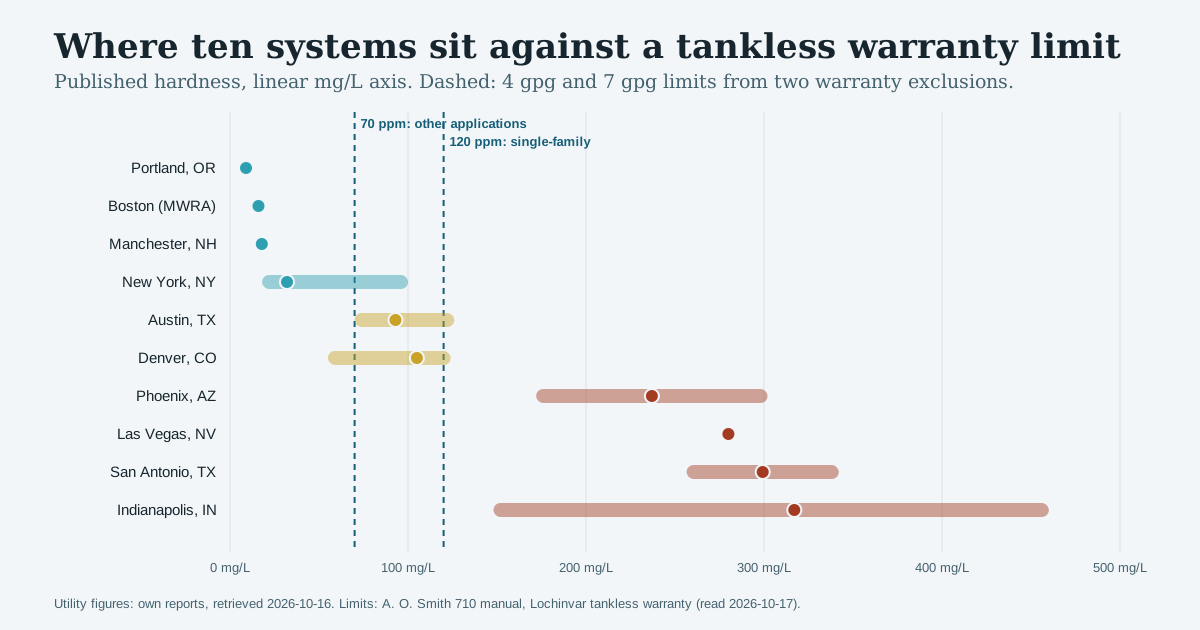
Here is where the published hardness of each water system on this site sits relative to the 70 ppm and 120 ppm lines in those two warranties. Each figure is the utility's own, as published; the classification against the lines is ours.
| System | Published hardness | Below 70 ppm? | Below 120 ppm? |
|---|---|---|---|
| Portland Water Bureau, Bull Run | 7 to 11 ppm | Yes | Yes |
| MWRA, Boston | about 16 mg/L | Yes | Yes |
| Manchester Water Works, 2022 | 16.7 to 18.8 ppm | Yes | Yes |
| NYC DEP | 18 to 100 mg/L, average 32 | Average yes; top of range no | Yes |
| Austin Water | 70 to 126 ppm, average 93 | No | Average yes; top of range no |
| Denver Water | 55 to 124 mg/L (from ppb), average 105 | Bottom of range only | Average yes; top of range no |
| Phoenix | 172 to 302 ppm | No | No |
| LVVWD, Las Vegas | 280 ppm average | No | No |
| SAWS, San Antonio | 15 to 20 gpg (256.5 to 342 mg/L) | No | No |
| Citizens Energy Group, Indianapolis | 148 to 460 ppm, average 317 | No | No |
The pattern falls into three groups. Four systems are comfortably under both lines on every figure they publish. Four are over both lines on every figure. Austin and Denver are the interesting middle: their averages are below 120 ppm, but the top of each published range is just above it, at 126 and 124. A household in either city on water near the top of the range could be over a 7-grain limit for part of the year.
That middle group is exactly where a published system figure stops being enough. Denver Water's quarterly results run from 55,000 to 124,000 ppb; the utility publishes them in parts per billion, which is 55 to 124 mg/L. If a warranty decision depends on whether your water is above or below 120, a test at your own tap is the figure that answers it. A utility figure describes the system, never one address.
How often to flush or descale
Rheem's published guidance for tank heaters is to flush once a year, or every six months with hard water, and its FAQ repeats both figures. For tankless heaters it says they "require periodic descaling instead of flushing" and does not give a single interval, because the right interval depends on the water and the unit.
What counts as "hard water" for that six-month figure is not defined on Rheem's page. Penn State Extension draws a practical line: it says hardness below 7.0 grains per gallon "will probably not cause major scaling and soap film". On the USGS scale, 7 grains (about 120 mg/L) is the top of the moderately hard band. So one reasonable reading is that the more frequent interval applies to the systems in the bottom four rows of the table above, and to Austin and Denver when their water is near the top of its range. Your manual's own schedule overrides that reading.
A practical point for anyone planning maintenance: Rheem suggests professional service if a unit is 8 to 12 years old or older. Flushing a heater involves hot water, gas or electrical connections and a drain valve that may not have moved in years. Follow the manufacturer's procedure for your model, and if you are not comfortable with it, that is what the annual check by a licensed technician in the A. O. Smith manual is for.
Softeners, scale-prevention systems and what each one does
Two different kinds of product are sold to deal with hard water at a water heater, and the manufacturers are explicit about which is which.
Water softeners remove hardness. Penn State Extension describes the ion exchange process: water passes through resin holding sodium ions, and the resin takes up calcium and magnesium in exchange. Soft water going into the heater means less mineral available to form scale. If a warranty sets a hardness limit in grains per gallon, a softener is the product that changes the measured number. The grain capacity calculator sizes one from your hardness and household, and what size water softener do I need walks through the arithmetic.
Scale-prevention systems for tankless heaters do not remove hardness. Navien's installation instructions for its PeakFlow A system say it "is not a water softener" and "will not reduce water hardness". It is listed for "tankless water heater protection" and "scale prevention only", is not approved for storage-type or tank-type heaters, and lists a maximum feed-water hardness of 75 grains (1,282 ppm). Navien's product page states that "scale build-up from hard water is the biggest single reason for unit failures" — that is Navien's claim about its own products' field experience, and it is a reasonable explanation of why a tankless manufacturer sells such a system. Stiebel Eltron's Scale TAC-ler Plus manual describes its product as an alternative to conventional softeners for reducing scale in tankless heaters, with a maximum treatable hardness of 75 gpg.
The distinction matters for the warranty question. A warranty that excludes water "measuring more than 7 grains per gallon" is written in terms of measured hardness. A product that prevents scale without lowering hardness does not change that measurement. Whether a given manufacturer accepts its own or another company's scale-prevention system as meeting its water-quality terms is a question for that manufacturer's documents, not for a general guide.
Hard water on the hot side of the rest of the house
The water heater is not the only place heated hard water deposits minerals, and several of the other places are where people notice it first.
Dishwashers heat water in their own element and many have a built-in softener for exactly this reason. Bosch's setting runs from H:00 to H:07, and the Bosch dishwasher hardness guide shows how to choose it from a utility figure.
Kettles and coffee makers show white scale on heating surfaces, which is the same calcium carbonate the USGS describes, on a smaller scale.
Showers and taps on the hot side show spots and film. Nebraska Extension notes that soap combines with hardness minerals into a sticky curd, which is the film on glass and tile.
Pipes, over a long period, can narrow. The USGS says pipes can gradually close up, reducing flow and water pressure.
None of this is a health matter. Nebraska Extension states that "hard water is not a health hazard", and the USGS says the same. It is a maintenance and efficiency question, which is why the useful sources are manufacturers' manuals rather than health agencies.
A checklist for your own heater
- Find your hardness. Start from your utility's report or, if you do not know which utility serves you, find your water system. On a private well, there is no utility figure; you need a test.
- Convert it to grains if needed. Divide ppm or mg/L by 17.1. The hardness converter shows the arithmetic, and Denver-style ppb figures need dividing by 1,000 first.
- Look at the range, not just the average. If the top of your utility's range is above your heater's limit, the average does not settle the question.
- Read your heater's manual and warranty. Look for the water-quality section and the exclusions. Note any hardness, pH or well-water terms.
- Note the maintenance interval. Flushing for a tank, descaling for tankless, at whatever frequency the manual gives.
- If your water is over the limit, a softener changes the measured hardness; a scale-prevention system does not. Check which one your manufacturer's terms are written around.
Sources and further reading
Scale formation and effects: USGS Water Science School, Hardness of Water, and Nebraska Extension, Hard Water (Calcium and Magnesium), G1274. The 7 gpg threshold: Penn State Extension, Water Softening. Warranty limits: the A. O. Smith 710 tankless installation manual and the Lochinvar Limited Tankless Water Heater Warranty. Flushing guidance: Rheem, How Often To Flush Your Water Heater. Scale-prevention systems: Navien PeakFlow A and its installation instructions, and Stiebel Eltron's Scale TAC-ler Plus manual. All read 17 October 2026. Utility figures are from each utility's own report, with its retrieval date on its page here; nothing in this guide was tested by WaterProfile Local.
The short version of hard water and water heaters: find your hardness, compare it with the limit in your own heater's documents, and keep to the flushing or descaling interval its manufacturer sets.
Frequently asked questions
Does hard water damage a water heater?
It can build scale. The USGS says that when hard water is heated, as in a home water heater, solid deposits of calcium carbonate can form, and that this scale can shorten equipment life and raise heating costs. Nebraska Extension says heated hard water forms a scale of calcium and magnesium minerals that can reduce appliance efficiency. How much depends on the hardness, the temperature and the type of heater.
How often should I flush my water heater if I have hard water?
Rheem's own guidance is once a year for most homes, or every six months if you have hard water. It also says tankless water heaters need periodic descaling rather than traditional flushing. Your model's manual takes precedence over any general rule.
What water hardness voids a tankless water heater warranty?
It depends on the manufacturer, so read your own warranty. The A. O. Smith 710 tankless manual and the Lochinvar tankless warranty both exclude damage from water harder than 7 grains per gallon (120 ppm) in single-family homes, or 4 grains per gallon (70 ppm) in other applications, and from water with pH below 6.5 or above 8.5.
Is a water softener or a scale-prevention system better for a tankless heater?
They do different jobs. A softener removes hardness. Systems such as Navien's PeakFlow A and Stiebel Eltron's Scale TAC-ler Plus are sold to prevent scale in tankless heaters without removing hardness; Navien's manual states plainly that its system is not a water softener. If your warranty sets a hardness limit, check whether it is met by a product that does not reduce hardness before relying on one.
Is my city's water hard enough to worry about for a tankless heater?
Compare its published figure with your heater's own limit. Of the ten systems on this site, Portland, Boston, Manchester and New York City publish figures well under 70 ppm. Austin and Denver straddle 120 ppm across their published ranges. Phoenix, Las Vegas, San Antonio and Indianapolis publish figures entirely above 120 ppm.