What Hard Water Does, According to Manufacturers
What hard water does, taken only from appliance makers' own published hardness limits and warranty wording — the numbers they state, and the ones they will not.
What hard water does is a question with a surprisingly short honest answer: the only organisations that put numbers on it are the companies that make the equipment it damages, and those companies disagree with each other. Everything below is taken from manufacturer manuals, manufacturer warranties and a trade association's own page, each fetched and read on 17 October 2026, with the wording reproduced as published. Nothing here has been tested by the author, and no figure appears that is not in a cited document.
That constraint rules out most of what gets written on this subject. The page currently ranking for austin water hardness leads with a section called "Austin's Water Hardness: The Hidden Home Destroyer" and states no numeric hardness value anywhere on it. This page states no consequence that a manufacturer or standards source did not state first.
The one number several manufacturers agree on: 7 grains per gallon
Three separate manufacturers, writing about three different appliances, treat roughly 7 grains per gallon — about 120 mg/L — as the point at which the owner has to do something.
A.O. Smith is the most direct. Its On-Demand Water Heater Installation Manual and Owner's Guide states, in its installation section:
"Water hardness levels must not exceed 7 grains per gallon (120 ppm) for single family domestic applications or more than 4 grains per gallon (70 ppm) for all other types of applications."
That is not advice. It is a stated condition of installation, followed by the reason:
"Water hardness leads to scale formation and may affect / damage the water heater."
and the instruction:
"Hard water scaling must be avoided or controlled by proper water treatment."
Bosch arrives at the same number from a different direction. Its dishwasher Operating instructions carry a water-hardness conversion chart with eight softener settings, headed verbatim ppm Grains/gallon (gpg) °dH. Setting H:00, the only one that needs no softener salt, covers 0 to 116 ppm, which the chart gives as 0 to 6 grains per gallon. From 117 ppm — 7 grains per gallon — upward, every setting requires salt in the dishwasher's salt chamber. The machine is built on the assumption that above 7 grains per gallon it has to compensate chemically on every cycle.
Rinnai puts 7 grains per gallon in the middle of its scale rather than at a limit, and it is worth being precise about the difference. Table 3 of its SENSEI RX Residential Installation and Operation Manual, headed "Recommended Water Treatment", runs:
| Classification | mg/L | Grains/gallon | Water treatment method |
|---|---|---|---|
| Soft | 0–60 | 0–4 | None |
| Slightly Hard | 61–120 | 4–7 | Water Softener or Rinnai Scale Cutter is Recommended. |
| Moderately Hard | 121–160 | 7–9 | see note below |
| Very Hard | 161–200 | 9–12 | Water Softener or Rinnai Scale Cutter is Strongly Recommended. |
| Extremely Hard | 200+ | 12+ | Water Softener or Rinnai Scale Cutter is Required. |
The treatment cell for the "Moderately Hard" row did not render legibly in the document as fetched, and the manual's "Recommended Flushing Frequency" column could not be attributed row by row with confidence, so neither is reproduced. The one flushing figure that is clearly readable sits against the "Slightly Hard" row: "Residential: Once/Year" and "Commercial: Twice/Year". A separate table in the same manual, Table 4 "Water Quality Guidelines", gives the appliance's stated hardness ceiling as "Total Hardness Up to 200 mg/L".
So Rinnai's language escalates in four steps — none, recommended, strongly recommended, required — and its "required" threshold sits at 12 grains per gallon, where A.O. Smith's absolute limit sits at 7. Both are manufacturers of tankless water heaters. If you want a single number for when hard water becomes a problem, that gap is your answer: there isn't one, and the people who build the equipment do not pretend otherwise.
Where your own system sits against those limits
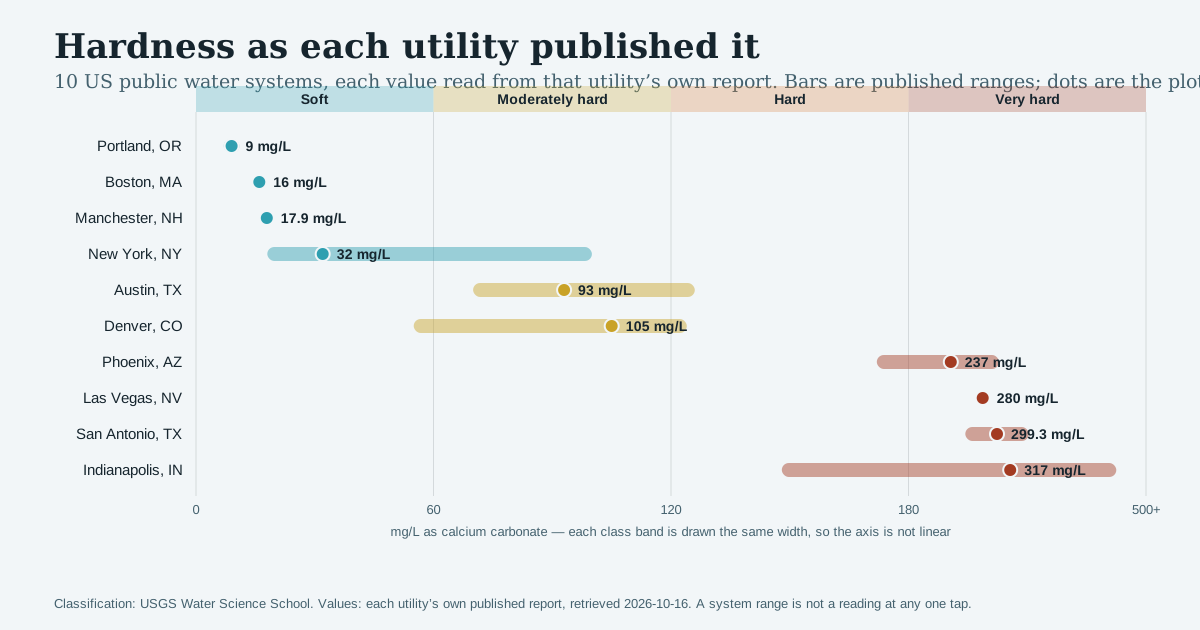
This matters because of how ordinary those thresholds turn out to be. Of the 44 public water systems transcribed on this site from their own published reports, 24 publish a figure above A.O. Smith's stated 7 grains per gallon limit, and 11 publish a figure above the 12 grains per gallon at which Rinnai moves from recommending treatment to requiring it. Only 9 sit in Rinnai's "Soft" row, where it asks for nothing at all.
Those counts are computed from the published figures on this site, not estimated. They are also a floor rather than an average of American water: these 44 systems are the ones whose utility published a readable number, which is not a random sample of anything.
The systems above 12 grains per gallon, where Rinnai's own manual says treatment is required rather than advisable:
- Tampa, FL — City of Tampa Water Department, 220 mg/L, 12.9 gpg
- Phoenix, AZ — City of Phoenix Water Services Department, 237 mg/L, 13.9 gpg
- Mesa, AZ — City of Mesa Water Resources, 239.4 mg/L, 14 gpg
- San Diego, CA — City of San Diego Public Utilities Department, 276 mg/L, 16.1 gpg
- Las Vegas, NV — Las Vegas Valley Water District, 280 mg/L, 16.4 gpg
- Chandler, AZ — City of Chandler, 282.2 mg/L, 16.5 gpg
- San Antonio, TX — San Antonio Water System (SAWS), 299.3 mg/L, 17.5 gpg
- Anaheim, CA — Anaheim Public Utilities, 300 mg/L, 17.5 gpg
- Indianapolis, IN — Citizens Energy Group (Indianapolis), 317 mg/L, 18.5 gpg
- Madison, WI — Madison Water Utility, 324.9 mg/L, 19 gpg
- Scottsdale, AZ — Scottsdale Water, 352.5 mg/L, 20.6 gpg
If your system is on that list and you have a tankless water heater, the manual in your own basement is the document to read, not this page. It will name a limit for your model, and that limit is a better authority on your equipment than anything a water-treatment company publishes about your city.
What the trade association says, and the number it does not give
The Water Quality Association is the US trade body for the water-treatment industry. It is the organisation with the strongest commercial reason in the world to publish a hardness threshold above which you need its members' products. Its Scale Deposits page publishes no such threshold.
What it does publish is a list of effects, which is the clearest inventory of consequences available from a source that is not selling one specific machine:
"Dissolved calcium and magnesium salts are primarily responsible for most scaling in pipes and water heaters"
"Hardness prevents soap from lathering by causing the development of an insoluble curdy precipitate in the water"
"Scale deposits from hardness buildup affects fixtures and appliances found throughout the entire home or business."
and, as signs of hardness: "Stiff, dingy laundry", "Mineral deposits on dishes and glassware", "High soap usage & need for fabric softeners", "Extra work to remove soap curd on bathtubs & shower stalls", "Scale build up in sinks, tubs, faucets & appliances", and — note the hedge, which is the association's own and is reproduced here unchanged — "High energy costs, possibly due to scale build-up in pipes and on appliances".
The only number on the page is a definition, not a threshold: soft water is "<1 grain of hardness per gallon (or <17.1 mg/L hardness)."
Read that carefully, because it is the most useful thing on this page. The industry body names the effects and declines to name the level. Every page you will read that confidently tells you hard water shortens your water heater's life by some specific percentage has gone beyond what the industry's own association is willing to put in writing.
What the warranties actually say
This is where hardness stops being an inconvenience and starts being money, and it is the part most consumer writing on the subject gets wrong in a specific way: the warranties read for this page do not void over hardness. They exclude the damage hardness causes, which is a different and more slippery thing.
Rinnai America Corporation Limited Warranty excludes:
"Improper maintenance (such as but not limited to scale build-up, freeze damage, or vent blockage)"
and separately:
"Any damage caused by poor water quality"
Neither clause mentions hardness, a grain, or a milligram. "Poor water quality" is undefined in the document.
A.O. Smith's Limited Gas Tankless Water Heater Warranty is more explicit about hard water and still names no figure. Its exclusions cover:
"Damages due to a lack of maintenance (e.g., water filter, water treatment system, vent blockage, scale or other mineral/sediment buildup, etc.)."
And its treatment of hard water is conditional on the model you bought. Units with the company's X3 technology:
"are eligible for warranty coverage of the heat exchanger for 15 years if failure results due to excessive scale or mineral accumulation in a hard water environment."
while:
"Exclusions for hard water and resultant scale or other mineral buildup-related damages still apply to bypass manifold units (M models) even with the addition of an optional X3 cartridge."
So one manufacturer sells, as a feature, warranty coverage for exactly the failure its standard warranty excludes — and the word doing the work in both the coverage and the exclusion is "hard water environment", which the warranty never defines in numbers. The practical consequence is that a hardness figure you can cite, with the utility's own report and date behind it, is a more useful thing to own than a vague sense that your water is hard. That is the whole reason this site reproduces the published wording rather than summarising it.
Numbers that look like thresholds and are not
Two figures turn up in manufacturer documentation that are easy to mistake for "the level at which hard water is a problem". Neither is.
Navien's PeakFlow S scale-prevention system lists, under "Water chemistry & limitations", a "Hardness (maximum)" of "75 grains (1282 ppm CaCO3)". That is the hardest water the product itself is rated to handle. It says nothing about when you need the product, and 75 grains per gallon is far above any figure on this site.
The Water Quality Association's Getting Smart With Softeners booklet notes that "hardness leakage may occur when treating water supplies with more than 30 grains per gallon of hardness". That is a limitation of ion-exchange softeners at extreme hardness, not a point at which hardness begins to matter.
Both are worth knowing precisely because they are the kind of number that gets lifted out of a specification table and reprinted as a health or damage threshold. A specification limit is a statement about a product. A hardness figure in a water quality report is a statement about water. They answer different questions.
What none of these sources will tell you
Set out plainly, so the gaps are as visible as the findings:
- No source read for this page quantifies appliance lifespan. Not one document gives a figure for how much sooner a water heater, dishwasher or washing machine fails at a stated hardness. If you have read such a figure elsewhere, ask what it is sourced to.
- No source quantifies the energy cost. The Water Quality Association says "possibly". That is as far as the industry's own association goes.
- No source quantifies extra soap or detergent. "High soap usage" is the published claim; no quantity attaches to it.
- No source read here addresses health. Hardness sits outside the enforceable drinking-water standards, and none of these documents treats it as a health matter. This page is about equipment and housekeeping, and makes no health claim in either direction.
- Nothing here was tested. Every statement above is a quotation from a document, with its source named below.
Turning this into a decision
The honest sequence is short.
- Get your own figure. If your utility is among the systems here, its published figure, the verbatim hardness line and the report year are on its page, and you can cite them. If it is not, the free federal lookups do it: find the water system that serves you walks through both steps. There is no ZIP-code answer on this site, and that page explains why there cannot honestly be one.
- Convert it into the unit your appliance uses. Reports publish mg/L or ppm; manuals and softeners use grains per gallon. The converter does the arithmetic in the open, and why the factor is 17.1 explains where the number comes from. Note that a published figure can be a range — reading a water quality report covers finding the hardness line and the units it is printed in.
- Read your own appliance's manual, not a hardness article. The manual names a limit for your model. If your system's published figure is above it, the manufacturer is already telling you what it expects.
- Test your tap before you spend money. A utility figure describes a distribution system over a sampling period, not a fixture in your house. If you are on a private well, no utility figure applies to you at all.
- Size against both ends of a range. Where a utility publishes a range rather than a figure, the two ends can produce very different answers; the grain capacity calculator sizes both and prints the gap.
Whether a softener is worth installing at your hardness is a judgement about your house and your money, and this site does not make it for you. It has tested nothing, sells nothing, and has no view on your plumbing.
What hard water does, then, is best stated the way the manufacturers state it: it forms scale, it defeats soap, and above roughly 7 grains per gallon several of the companies that build household water equipment begin asking owners to treat it — one of them as a condition of installation, another as a warranty-relevant maintenance duty, and a third by dosing salt into every dishwasher cycle. Beyond that, the documents stop, and so does this page.
Sources
Every document below was fetched and read on 17 October 2026.
- A.O. Smith, On-Demand Water Heater Installation Manual and Owner's Guide — assets.aosmith.com
- A.O. Smith, Limited Gas Tankless Water Heater Warranty — assets.hotwater.com
- Rinnai, SENSEI RX Residential Installation and Operation Manual — media.rinnai.us
- Rinnai America Corporation, Limited Warranty — media.rinnai.us
- Bosch, dishwasher Operating instructions 9000922265 — media3.bosch-home.com
- Water Quality Association, Scale Deposits — wqa.org
- Water Quality Association, Getting Smart With Softeners — wqa.org
- Navien, PeakFlow S product page — navieninc.com
Frequently asked questions
At what hardness does hard water start causing problems?
No standards body publishes that number. The only organisations that publish one are appliance manufacturers, writing about their own equipment, and they disagree: A.O. Smith's on-demand water heater manual states hardness must not exceed 7 grains per gallon for single-family use, while Rinnai's SENSEI RX manual calls 4 to 7 grains per gallon 'Slightly Hard' and only makes treatment 'Required' above 12 grains per gallon. Bosch's dishwasher starts dosing softener salt at 7 grains per gallon. Treat 7 grains per gallon as the level at which several manufacturers start asking you to do something, not as a line where damage begins.
Will hard water void my water heater warranty?
The warranties read on 17 October 2026 do not name hardness as a cause of voiding, but both exclude the damage it produces. Rinnai's limited warranty excludes 'Improper maintenance (such as but not limited to scale build-up, freeze damage, or vent blockage)' and 'Any damage caused by poor water quality'. A.O. Smith's gas tankless warranty excludes 'Damages due to a lack of maintenance (e.g., water filter, water treatment system, vent blockage, scale or other mineral/sediment buildup, etc.)'. Neither states a hardness figure, so neither tells you whether your water is inside or outside the exclusion.
Does hard water damage pipes?
The Water Quality Association states that 'Dissolved calcium and magnesium salts are primarily responsible for most scaling in pipes and water heaters' and lists 'High energy costs, possibly due to scale build-up in pipes and on appliances' among the signs of hardness. The hedge in 'possibly' is the association's own wording and is reproduced here unchanged. No source read for this page quantifies the effect on a pipe, and this site has measured nothing.
Does hard water mean I need to use more soap?
The Water Quality Association states that 'Hardness prevents soap from lathering by causing the development of an insoluble curdy precipitate in the water', and lists 'High soap usage & need for fabric softeners' and 'Extra work to remove soap curd on bathtubs & shower stalls' among the consequences. It attaches no quantity to any of those, so nothing on this page says how much more soap.
How do I find out my own water hardness?
If your utility is one of the systems transcribed here, its published figure, the verbatim wording of its hardness line and its report year are on its page. If it is not, the finder page walks through the two free federal lookups that name your water system and locate its annual report. For sizing equipment, a test at your own tap beats any published figure, including the ones here, because a utility figure describes a distribution system and not a fixture.
Is a water softener worth it at my hardness?
This site does not answer that, because answering it needs a judgement about your house, your equipment and your money that no published figure supplies. What it can do is put the published number next to the manufacturer limits on this page, so the question becomes concrete: if your system's figure is above the limit printed in your own appliance's manual, that manual is telling you to act, and it is a better authority on its own equipment than anybody selling a softener.